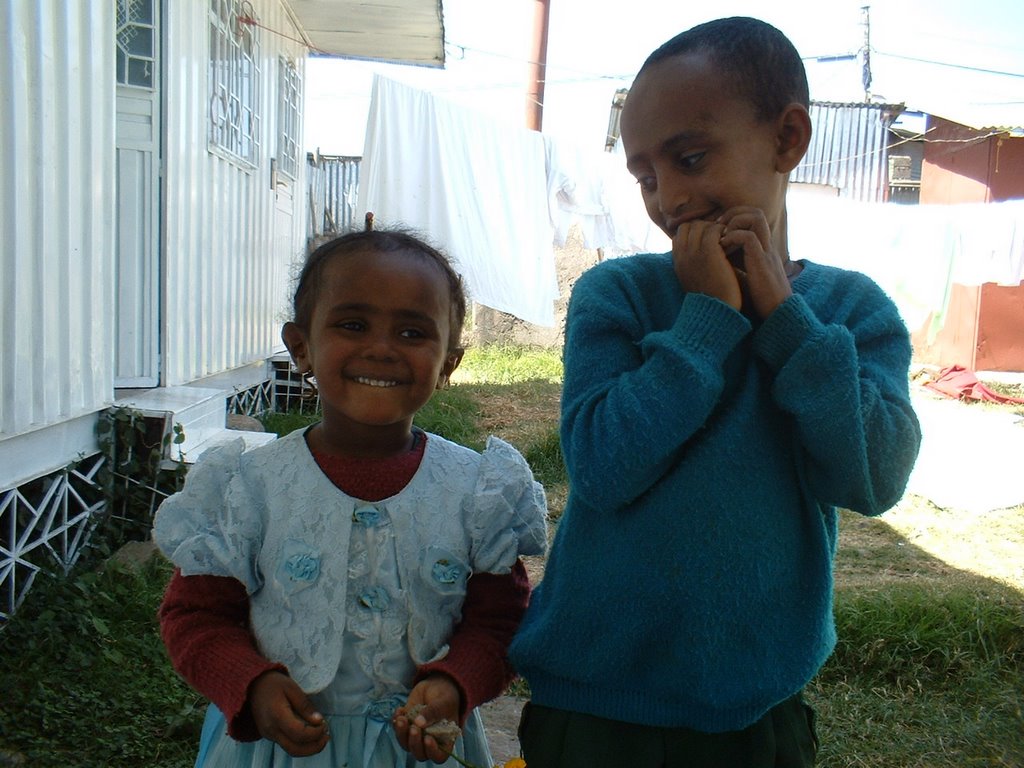
Monday, September 28, 2009

Light Within (Ethiopia)- Day 1

Pictures by: Nasir Al-Amin
Location: Addis Ababa, Ethiopia

"It is not just in some; it is in everyone. And, as we let our own light shine, we consciously give other people permission to do the same. As we are liberated from our fear, our presence automatically liberates others." (Our Deepest Fear)

Click here to see more photos from Day 1 on Facebook!

Leaving for Ethiopia: Cleansing the Lens of the Soul!

By: Nasir Al-Amin
*This blog entry was orignially posted on April 28, 2009. It is being reposted as the following blog entries will contain pictures and reflections from this journey.

Tonight, I have a redeye flight to Ethiopia. My journeys to Ethiopia always have a dual agenda/reality attached to them. Outwardly, my journeys are work related. Inwardly, they are transformative, therapy for soul, a stimulus to refocus. Thus, the outward and inward aims of this trip are the following:

1) Yousef: One of the orphans we work with has been in the hospital for a month. Previously he was diagnosed with HIV+ and I have been informed that his body has adjusted to his medication, and thus stopped working effectively. I hear he is in critical condition, so my main aim is to check on him.

2) Commercial Sex Workers (CSW): Last year we launched a project to provide skill training (sewing and tailoring) to 10 women engaged in CSW. I'm going to follow-up with them the about skills they have gained and their life post-intervention.

3) Orphans and Vulnerable Children (OVCs): In partnership with HAPSCO, an NGO based in Ethiopia, ALIF provides monetary assistance for school fees, food, and housing to impoverished and/or HIV/AIDS infected children that have lost one or both parents.

4) Donated School Supplies: A Kuwaiti volunteer, Noura,
donated school supplies for the children we serve. Therefore, I will have the pleasure to see their smiles as I give them the supplies.

5) Listen, Observe and Reflect: My first trip to Ethiopia in 2002 fostered a paradigm shift, in that the way I viewed the world and my role in it changed significantly. Each subsequent trip has helped to cleanse the lens through which I perceive, understand and process life experiences and the realities of others. The poor and marginalized have given me something priceless: "the gift of perspective."

"Where we direct our attention, is where our life flows"

Source: Seven Spiritual Laws of Success

"Life is a force flowing through us. Where we direct our attention, is where our life flows. Every moment is an opportunity to direct our attention to ideas that inspire us. Every day brings the promise of a new beggening, and the opportunity to transform every life challenge into a gift."

The Power of Compassion

By: Dalai Lama
Source: The Middle Way (text)
"I respect the world’s political leaders, but sometimes I think they should have more compassion. If even one of these political leaders cultivates more compassion, then millions of innocent people get more peace. "

The following are direct quotes from the text:

I often tell audiences that the twentieth century was a century of violence, and through that experience we now know that violence cannot solve problems. The only way to solve them is with peaceful resolution. Therefore, the twenty-first century should be the century of dialogue. For that, we need determination, patience, and a broader perspective. Again, this is where compassion has an important role. First, as I mentioned, it brings us self-confidence. Compassion brings us deep recognition of others’ rights. Compassion also gives us a calm mind, and with a calm mind, we can see reality more clearly. When our mind is dominated by afflictive emotions, we can’t see reality, and we make poor decisions. Compassion gives us a more holistic view.

I respect the world’s political leaders, but sometimes I think they should have more compassion. If even one of these political leaders cultivates more compassion, then millions of innocent people get more peace. Many years ago, at an official function in India, I met a politician from the Indian state of East Bengal. The meeting included a discussion of ethics and spirituality, and he said, “As a politician I don’t know much about those things.” He was probably just being humble, but I gently chided him. Politicians need more ethics, more spirituality, I said. If a religious practitioner in a remote area does something harmful, it probably doesn’t have much global effect. But when leaders and politicians are not mindful and compassionate, it is very dangerous.

I believe compassion is not a religious matter. Some people think compassion and forgiveness are the domains of religion, and if people have a negative view of religion they may become negative about these things as well. That’s a mistake. Whether we accept a religion or not is up to the individual, but as long as humanity inhabits this world, these deeper values are crucial and must not be neglected. Everybody is making every effort for material prosperity. That’s fine, but if in the meantime we neglect our inner world or inner values, we will not be happy. We must combine material development with the development of internal, human values. We need to develop respect, love, and a sense of compassion in order to have happier lives, happier families, happier communities, and finally a happier world. We need these inner qualities.

Click here to read the full selection!

Saturday, September 26, 2009

Distance Doesn't Matter Only the First Step...

Source: http://www.lessonsoftheday.blogspot.com/

"We must not.....ignore the small daily differences we can make which, overtime, add up to big differences that we often cannot foresee. The man who removes a mountain begins by carrying away small stones. A terrace nine stories high begins with a pile of earth. The distance doesn't matter only the first step is difficult."

Click here to read this and other reflections.

Wednesday, September 23, 2009

Awakening: Ambiguity Fosters Clarity

By: Nasir Al-Amin
(This was my first post after returning from a 6 month stay in Ethiopia, it was written on February 18, 2006.)

Ethiopia was a moment of awakening. It brought the numbers to life; the figures (4.6 million orphans, and 200,000 children living on the streets of Addis) became tangible. The words (domestic workers, poverty, commercial sex workers, child labourers, orphans, under-five mortality rate, and beggars) were now faces, individuals that I built relationships with, people I ate and laughed with, people I hugged and lent a shoulder to in moments of sorrow. In essence, my reality had changed. My perspective and/or worldview was altered by the realty of others. The children and their families became the center. My life, rather my life’s purpose was no longer about me. And it was this shift that nurtured a dormant seed of discontent that subsequently, led to a year of isolation, self-reflection and reprioritization.

After I returned to the States, I would often isolate myself (at first unknowingly) from friends (especially my Ethiopian friends) and environments (Ethiopian restaurants and cafés) that at best reminded me of Ethiopia and at worst subjected me to that dreaded question: “How was Ethiopia?” As Ethiopia was no longer this tranquil place, an escape from America’s dominant culture and norms, a bastion of generosity and love, my own little gem, this utopia that the West had not conquered or found. Ethiopia (both figuratively and literally) in all it splendor had changed and I could no longer articulate this new reality. My life experiences, Columbia diction and education could not prepare me for the emotional component of my endeavor. The veil had been removed, and what I saw left me speechless.

What words can speak to the reality of desperate girls walking the streets at night selling their bodies, or a teenage mother and her baby after a day of begging trying to sleep and stay warm on the sidewalk wrapped in tattered and soiled blankets—shockingly, often one sees groups of street children huddled together employing body heat as their sole means of staying warm. How does one express that somber feeling when children run to your vehicle at traffic lights placing their hands and faces on the car window with a dismal gaze begging for food or coins?

Unfortunately, for some Ethiopians living abroad and in Ethiopia, this reality has become normalized and thus they have become desensitized to the destitute and their plight. So much so that when they speak of Ethiopia and/or their trip back to Ethiopia the latter (destitute families and children) are not apart of the discussion—for instance, some will rave over the industrial improvements of Addis (which is laudable), yet fail to recognize that the conditions that give rise to street children, prostitution, child labour and exploitation have failed to improve. How do I reconcile these two worlds? How do I express to people that their $5-$10 dollar a week Starbucks addiction could change the life of a child begging on the streets of Addis, as this same amount of money could take a child from the streets into the classroom, and secure food, a school uniform and supplies. How do I convey to people that the cost of dinning out two nights a week if collected at the end of one month, could prevent an uneducated and desperate girl from resorting to prostitution for a year.

TO BE CONTINUED…

Tuesday, September 22, 2009

Ethical Travel: Child Exploitation Tourism Video

Source: Action to End Exploitation
Beyond Borders Newsletter, Issue no. 10, Spring 2007


The following are direct quotes from the aformentioned site:

Tips for travellers
*Be vigilant when you travel to high risk countries. Avoid bars and hotels and other places where you suspect child sexual exploitation might be happening.

*Don't visit red light districts. This encourages the proliferation of child sexual exploitation. Even the most innocent of purchases provides indirect financial support for this crime.

*If you suspect child sex tourism when you are abroad, report it to the local police inform the nearest Canadian embassy, or access www.cybertip.ca to report it. Tell your tour guide and hoteliers. Encourage them to inform tourists that sex tourism is a crime.

*When you return home, let your travel agent and tour operator know of your observations and encourage them to take action.

*Visit www.thecode.org to find out the tour operators and travel agencies that have committed to fight against child sex tourism by signing on to an international code of conduct for the tourism industry. if you can use their services, then do.

Click here to read more and watch the video.

"My children cry out for food day and night"

Source: IRINnews

The following are direct quotes from the article:
YEMEN: Huda Omar, "My children cry out for food day and night"

Huda Omar, 30, fled war-torn Somalia by boat in 2006 to Oman, where she spent more than two and a half years before paying traffickers to smuggle her to Yemen.But in Yemen she is eligible for protection only, and not support, as she has not been allowed to register as a refugee with the UN Refugee Agency (UNHCR). Living in the street with her two young daughters, just metres away from UNHCR’s office in Sanaa, Huda told IRIN her story.

“No one helps us… I and my two children have no income. I am forced to beg for money from passers-by to feed my children and myself. “I have been living in this place for three months without any way to clean, or get drinking water. Nobody cares about my suffering.

“My children cry out for food day and night and I barely sleep at night because of my illness and hunger. My condition is getting worse with time because I don’t have good food and medicine.“My dream in life is to have a shelter for me and my children, and enough food and clean water. But I don’t know if it is possible for me to achieve this dream before I die.”

Click here to read the full article.

Call Firestone TODAY!: World Day Against Child Labor!

Source:Change.org

The following are direct quotes from the article/video:

Take action today to stop child labor on the Firestone rubber plantation in Liberia by calling Bridgestone Americas CEO Mark Emkes at 615-937-1000 and tell him to switch from a quota pay system to a living daily wage for workers on his rubber plantation in Liberia.

For 82 years, Firestone has operated a rubber plantation in Liberia where there is widespread child labor, abuse of workers’ rights and environmental destruction. Workers have an extremely high production quota they must meet every day or their low wages are halved — which means they have to bring their children to work to meet their quota. After a long struggle, the workers on the plantation finally have democratic and independent union. The union is negotiating their new collective bargaining agreement with company management right NOW. The biggest demands for the workers is to switch from a task-based pay system to a living daily wage. Firestone can honor World Day Against Child Labor today by agreeing to end the quota system, but they need pressure from you!

So CALL Bridgestone Americas CEO Mark Emkes at 615-937-1000! Ask for Mark Emkes and say, “On World Day Against Child Labor, I want you to take action to end child labor on your rubber plantation in Liberia by switching from a quota system to a daily wage with a living salary.” Then, call Dan Adomitis at the Firestone Natural Rubber Company at 317-575-7281 or 317-575-7000 and tell him the same thing.

Click here to read the full article.

Saturday, August 01, 2009

Ethiopia's orphans face life of hardship

Source: Timesonline (Jonathan Clayton)

The following are direct quotes from the article:

A few miles away, dozens of children sleep in drains at night and beg by day at the sprawling central bus station. They face constant dangers. “Some are forced into prostitution, some are sold by relatives after their parents die, they are kept as maids and often abused,” said Dagmawi Alemayeau who runs an organisation, Forum on Street Children, which tries to fight trafficking. Most of an estimated 50,000 children on the streets of the capital, Addis Ababa, at some stage pass through the bus station where he has his office.

“Traffickers go to the rural areas ... there are places where you can even buy a baby for as little as $1, he told The Times. He always keeps an eye open at the international airport where so-calleduncles” can often be spotted boarded planes to Gulf states with teenage girls.

Across the rest of Africa, a combination of soaring populations, growing poverty and the HIV-Aids epidemic has led to a huge increase in orphans. A UNICEF report estimates that in sub-Saharan Africa alone there will be more than 20 million by 2010.

Click here to read the full article.

Saturday, July 11, 2009

ZIMBABWE: OVC may be at greater risk of sexual abuse

Source: IRIN PlusNews
The following are direct quotes from the article:
Girls who have been orphaned may be twice as likely to experience sexual abuse, according to research from child-friendly clinics in Zimbabwe's capital, Harare. Dr Eunice Lyn Garura, director of the Family Support Trust, an NGO operating clinics for survivors of sexual abuse, said 30 percent of the predominantly female clients were orphans who had lost both parents.

Click here to read the full article.

Saturday, July 04, 2009

MALAWI: No money, no services

Source: IRIN
The following are direct quotes from the article:
Interviews with OVC identified food - by a wide margin - as their chief concern, followed by access to clothing and school. They saw themselves as excluded from community and health services, and the report stressed the danger of commercial sex work as a means of meeting those needs.

EQUINET recommended the widening of community social safety nets, introducing communal farming schemes, and income-generating projects to support OVC. It also called on the government directly to address the shortages in CBO funding, and improve social protection services.

Click here to read the full article.

Monday, June 22, 2009

RWANDA: Vulnerable children living on the margins

Source: IRIN
The following are direct quotes from the article:
Lambert Rukeratabaro has turned 16, but is still only in the fourth year of primary school in Byumba, north of the capital, Kigali.  Like thousands of Rwandan children who lost their parents in the 1994 genocide or more recently to HIV/AIDS, Rukeratabaro is an orphan.

"I have been told that my parents died during the genocide," he told IRIN. "Our life is hard. Our parents left us some land so when the harvest is good, we have enough food for lunch and supper." Rukeratabaro's two sisters work on other farms to earn some money. "My sisters had eye and skin problems and it was very difficult getting medication," he said.

"There are at least 2.8 million vulnerable children in the country," said Gisele Rutayisire, the officer in charge of social protection and governance for child rights with the UN Children's Fund (UNICEF) in Kigali.  An estimated 100,000 Rwandan households are headed by children.

Rukeratabaro said his dream would be to continue his education but he lacks money and relies on well wishers for support with school materials.

"Although I am not very good at school I would like to study up to university so that I can assist my family," he said.

Saturday, June 20, 2009

CAMEROON: Bringing street children back home

Source:IRIN
The following are direct quotes from the article:
Ousmanou, 13, has lived in the streets of Cameroon’s political capital Yaoundé for four months. He and his brother used to live with their grandmother in the northern city of Maroua but she could not afford to feed them properly. Now Ousmanou often forages for food in trash bins.

“We often have no choice but to search the garbage for something to eat,” he told IRIN, nursing an arm injury for which he said he cannot afford to see a doctor. He said he has been unable to find work as he had hoped and has turned to begging.

Reasons for children ending up in the streets vary, from economic hardship to family conflicts to peer pressure, according to ministry interviews with children. Many children in Yaoundé told IRIN they left home desperate to find work, their families unable to support them. But most said they regret their decision, having hit a dead end.

He added: “Children are used to transport drugs; they are recruited into gangs."

Click here to read the entire article!

Thursday, June 04, 2009

KENYA: Domestic workers often do more than housework

Source: IRINnews
The following are direct quotes from the aforementioned article:

*When Nora Adhiambo, 21, started working as a housekeeper for a family in the Kenyan capital, Nairobi, she expected to cook, clean and look after their young children; not that she would have to regularly have sex with her employer.

*"He would force me to have sex with him; every time he would sleep with me without a condom and this went on for two years," she told IRIN/PlusNews. "He threw me out when I told him I was pregnant; I realised later that I had not only left that house with a pregnancy but also HIV."

*Salaries are sometimes so low that they are forced to seek additional sources of income, including sex work; those forced out of their employer's home after being raped may resort to sex work as the only way to survive.

Click here to read the full article!

BENIN-NIGERIA: Learning English to enter the sex industry

Source:IRINnews/PLUSNews
The following are direct quotes from the aforementioned article:

Many young people in French-speaking Benin are learning English to adapt to globalization, but some young women have another goal: to enter the thriving sex industry in neighbouring Nigeria, where the market is considered more lucrative.

"Some of them, for example, go to learn English ... in Nigeria, for further study - not all of them go with the intention of becoming [sex workers], but their circumstances push them into it," said Legonou, who emphasized the need to "concentrate on awareness-raising of young girls", particularly to the risk of HIV.

Amy, a young sex worker near one of the big hotels in the city, came from Ivory Coast in 2007. She said she made enough money to rent an apartment for US$400 a month in a suburb of Abuja.

Nigeria has 2.6 million people living with HIV - the third highest HIV caseload in the world after India and South Africa – and a prevalence rate of 3.1 percent, compared to 2 percent in Benin, but this does not discourage young people.

Click here to read the full article!

WEST AFRICA: Combating world's lowest literacy rates

Source: IRINnews
The following are direct quotes from the aforementioned article:


*Illiteracy rates in West Africa are the highest in the world, cramping development and weakening citizens’ power to effect socio-economic and political change,

*Sixty-five million West African adults – 40 percent of the adult population – cannot read or write according to a new study, 'From closed books to open doors – West Africa's literacy challenge'.

*Of the 10 countries with the world’s lowest recorded adult – 15 and older – literacy rates, seven are in West Africa: Benin, Burkina Faso, Guinea, Mali, Niger, Senegal and Sierra Leone, the report says.

*An educated population will also show stronger support for democracy

*Education activist and former child soldier in Sierra Leone, Ishmael Beah, told IRIN: “Education is not only something to get a career or change your socio-economic status, but it is a way you can begin to understand your government and demand more of it.”

*Rich country aid to education in West Africa in 2007 was equal to just one per cent of what the US government spent on bailing out [insurance company] AIG alone,” Pearce said.

*When supporting education donors should pay more heed to literacy, the report says.

Click here to read the full article!

Sunday, May 24, 2009

Your purpose is beyond you...

"Past the seeker as he prayed
came the crippled and the beggar and the beaten.
And seeing them...he cried
"Great God, how is it that a loving creator
can see such things and yet do nothing about them?"
God said "I did do something. I made you."
(Sufi Teaching)

Saturday, May 23, 2009

The Secret of Living Well...

The secret of living well is not in the answers we amass but in the actions we take. No matter how many problems we solve, there will always be new ones to take their place. We can be more masterful in life if we allow problems to be an ever-present, challenging, and stimulating aspect of living. Accepting and embracing our own humanity is one of the secrets of living life truly satisfied and free of suffering.

[Judy Tatelbaum, You Don't Have to Suffer]

Friday, May 08, 2009

Build and live in a new world...

To change the world we do not need to manipulate people or events; we need to change our minds. Effective transformation springs naturally from higher vision. As we open to a higher reality, we find evidence to support it. Everyone who has improved the world has seen a bigger picture than the one most people were living, and found the courage to live as if it were already so.

Our history is not our destiny. You and I are here to build and live in a new world. Your role in bringing about that world is much simpler than you have realized. You are not required to become a world leader, invent a revolutionary mode of travel, or discover a miraculous medicinal panacea. Your purpose here is much more personal and relevant to the life you are now living. You are here to discover and release the beliefs that have kept you living in a circle smaller than your potential, and step into a world that honors the greatness within you and everyone you meet. You are here to claim your vision and walk in the light. You are here to be you.
[Cohen, The Dragon Doesn't Live Here Anymore]