Friday, March 24, 2006

THE TRUE VALUE OF LIFE: CULTIVATING HOPE IN AN ATMOSPHERE OF DESPAIR

By: Nasir
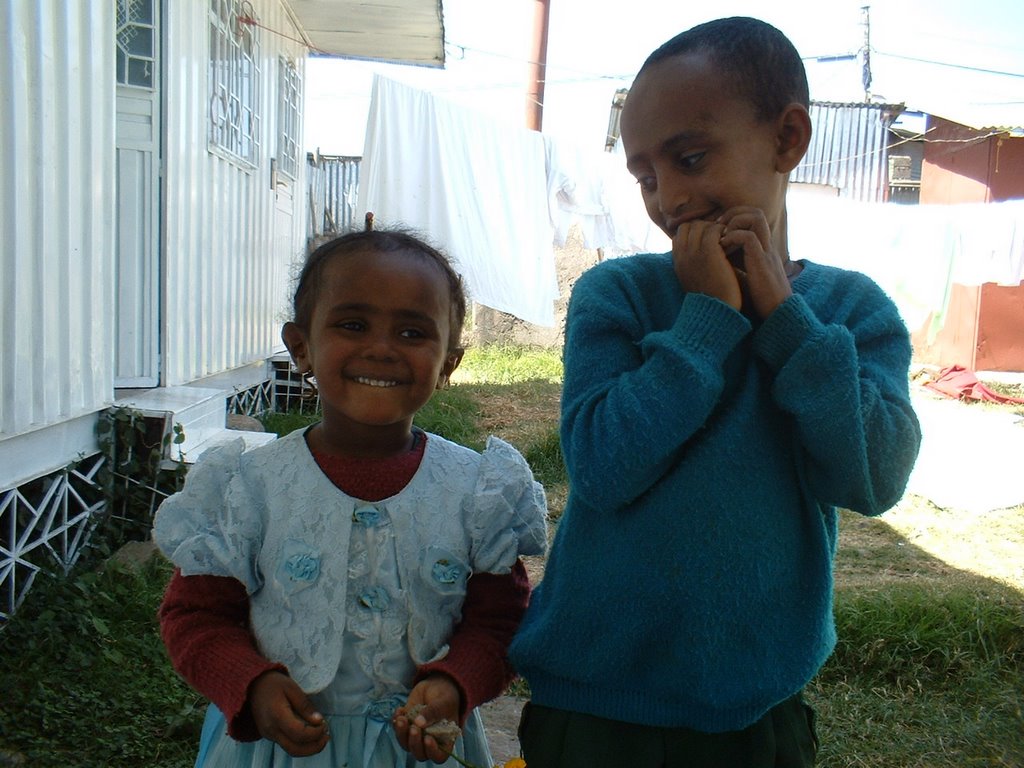
The true value in life is cultivating hope in an atmosphere of despair. You look to me with a glimmer of hope, and I in turn up hold a facade, as deep inside I know…I know that you lost your father to AIDS…I know that your mother is stigmatized in the community and unable to secure employment…I know that you missed breakfast and only had bread for lunch…I know your older sister is engaged in prostitution to secure food, clothing, shelter, and a means to escape reality…I know you cannot afford the cost of school fees, a uniform, and school supplies…I know when you play with other kids their parents drill them to stay away from you…I know your sister crossed the Red Sea to be a servant…I know you had a funeral for your mother as she lost her fight with AIDS…

The true value in life is cultivating hope in an atmosphere of despair.

Yet it’s the tedious process of cultivation that creates despair.

Wednesday, March 22, 2006

"CONFLICT DIAMONDS"/"BLOOD DIAMONDS" Fuelling War & Child Labor

Via:UN
What follows are excerpts from a UN article on "Conflict Diamonds":

What is a conflict diamond?
Conflict diamonds are diamonds that originate from areas controlled by forces or factions opposed to legitimate and internationally recognized governments, and are used to fund military action in opposition to those governments, or in contravention of the decisions of the Security Council.

How can a conflict diamond be distinguished from a legitimate diamond?
A well-structured 'Certificate of Origin' regime can be an effective way of ensuring that only legitimate diamonds -- that is, those from government-controlled areas -- reach market. Additional controls by Member States and the diamond industry are needed to ensure that such a regime is effective. These measures might include the standardization of the certificate among diamond exporting countries, transparency, auditing and monitoring of the regime and new legislation against those who fail to comply.

Fuelling wars
Rough diamond caches have often been used by rebel forces to finance arms purchases and other illegal activities. Neighbouring and other countries can be used as trading and transit grounds for illicit diamonds. Once diamonds are brought to market, their origin is difficult to trace and once polished, they can no longer be identified.

Who needs to take action?
Governments, inter-governmental and non-governmental organizations, diamond traders, financial institutions, arms manufacturers, social and educational institutions and other civil society players need to combine their efforts, demand the strict enforcement of sanctions and encourage real peace. The horrific atrocities in Sierra Leone and the long suffering of the people of Angola have heightened the international community's awareness of the need to cut off sources of funding for the rebels in order to promote lasting peace in those countries; such an opportunity cannot be wasted.

Tuesday, March 21, 2006

ZIMBABWE: Child labour on farms must be stopped, say unions

Via: IRIN
HARARE, 10 Mar 2006 (IRIN) - "As standards of living in Zimbabwe continue to deteriorate the use of child labour on farms has risen sharply, with over 10,000 children estimated to be working in the agricultural sector. Gertrude Hambira, secretary-general of the General Agricultural and Plantation Workers Union of Zimbabwe (GAPWUZ), told IRIN that her association would seek the assistance of the UN Children's Fund (UNICEF) to end child labour on farms. She said children aged 16 years and under working on farms were regarded as child labourers."

"We are finalising our reports, which we want to bring to the attention of UNICEF, so that they can intervene and protect the rights of children. Children should be in schools and not working on farms," said Hambira.IRIN recently reported that new commercial farmers, the beneficiaries of the government's controversial land redistribution programme, were struggling to pay labourers."

"According to statistics, an average family needs Zim $28 million [US $282] a month to meet its basic requirements. However, our members are being paid Zim $600,000 [$6] a month, which is only enough to buy a bar of soap and cooking oil. This has exposed children to abuse by commercial farmers, who are making them work on their farms in exchange for a free education on farm schools," Hambira alleged."

"New farmers using child labourers in exchange for an education have dubbed the system 'Learn as you earn'.Hambira added that because the wages of farm workers could not sustain their families, children were also being employed to supplement family incomes. "In some instances we have cases of parents and their young children all working on the farm so that they can pool their earnings to buy food and other basic necessities," she commented."

"Hambira said some of the children working on farms had been displaced by the government's Operation Murambatsvina last year - an urban cleanup campaign. "In addition, children are now dropping out of school because school fees are beyond their reach, as some government schools are charging fees of Zim $400,000 [$4] a term," she added."

SOMALIA: Revised humanitarian appeal launched

Via: IRIN
NAIROBI, 21 Mar 2006 (IRIN) -
"Aid agencies have launched a revised appeal for US $326.7 million to avert a humanitarian disaster in drought-stricken Somalia, where some 2.1 million people are threatened with starvation following several successive seasons of failed rains.

"This current drought is unprecedented in 10 years, and the impact it is having on food, water, health, education and livelihoods is alarming," said Christian Balslev-Olesen, the United Nations acting humanitarian coordinator for Somalia, during the launch of the revised Consolidated Appeal Process (CAP) on Tuesday.

"Humanitarian agencies had asked for $174 million in December 2005 to help drought-affected people in Somalia. As of 20 March, donors had committed $79,703,293 million - about 25 percent of the funds required to sustain humanitarian operations in Somalia until the end of 2006. Almost 83 percent of the increase in funding requirements is due to additional food needs, according to the appeal statement prepared by the UN Office for the Coordination of Humanitarian Affairs (OCHA)."

"What we need is sustained, consistent effort," said Philippe Lazzarini, the head of OCHA-Somalia. The projections for the next gu (long) rains are below normal, he said.Failure to provide timely assistance could increase the needy population and deepen the humanitarian crisis to a generalised famine situation, according to OCHA.

"This may serve to undermine the political process and the ongoing, local reconciliation initiatives," the agency added. General food distributions needed to be stepped up to avoid deaths by starvation, which could occur "in a matter of months" if aid was delayed, Balslev-Olesen said."

Monday, March 20, 2006

'Care needed' for Aids children

Via:BBC
"Millions of children whose mothers live with HIV/Aids are not receiving enough long-term care and support, says a new UK charity report.

"Up to nine million children in Africa have lost their mothers to HIV/Aids, Save the Children found. The charity called for new efforts to improve care and support for children who lose one or both parents. Many children are compelled to care for their sick mothers, the charity said, missing school to earn money instead. "

"Up to 90% of 19 million women living with HIV/Aids around the world are mothers, it said. In the countries worst hit by Aids, children are often left to care for their younger siblings, or their grandparents take the role of the deceased parents."

Environmental Factors

Is this an environment for children to flourish in?

Sunday, March 19, 2006

Period misery for Kenya schoolgirls

"A large number of girls in rural Kenya skip school at the time of their menstruation because they cannot afford to buy sanitary towels or tampons."

"It's estimated some girls miss more than a month of school each year . The cost of these monthly necessities has been highlighted by women campaigners in Zimbabwe, where the economic crisis has led to shortages and prohibitive prices."

"But it is a problem experienced by many across Africa, and Kenya in particular, where 54% of people live on less than $1 a day. "I normally lie. I always say that I'm sick at the time of my period," says Soudah Gurhan, a student in Wajir, north-eastern Kenya."

"Zainabu Mohammed, a teacher at Wajir's Dambas primary school, says this is the case with many of her female pupils. "The children that can't afford them miss lessons until their period is over. When they report to classes, they normally say that they were sick because they have no other reason to give out," she says. "

Race and Class: An Impetus For An “Us and Them” Worldview

by: Nasir Al-Amin
Call it a selfish-pleasure, this opportunity to disconnect from normative vices, but being in Ethiopia frees me from various mundane vices I as an African American have grown to accept as the status quo. In Ethiopia people assume my ethnicity is Ethiopian, Arab or a mixture of the two. Hence, initially I’m not treated as a foreigner; rather I'm treated as someone who belongs. Ironically, this feeling of belonging, albeit founded on a false pretense, feels more genuine than the pseudo belonging I experience in my country of origin. As to often in the country of my birth I’m reminded of my ethnicity, and the devaluing and divisive stereotypes of African Americans.

Last week I ventured out of New York City to attend a conference at the University of Maryland. Upon leaving the metro station in search of the campus I stopped a passerby and inquired about the conference’s location. A conversation ensued and we began to trek together as our destinations were in close proximity to one another. Instantly, we both realized that we both were Muslims (the spot on my forehead from prayer and her hijab, gave it away for both of us) but could not figure out each other’s country of origin. While waiting for the taxi we both shared our ethnic background and our love for Islam. Subsequently, we shared a taxi and continued our conversation. As the driver maneuvered through the streets she began to tell me about life in Saudi Arabia. Once we approached her destination we gave each other Salaams and I proceeded in the taxi. During the ride I asked the driver what is it like driving a taxi in the Maryland area. He replied, “Its ok. I mean its good, but the blacks…the African Americans they will rob you. There so damn evil. I mean you have to watch them.” The driver went on this desultory philippic about African Americans, and I sat there not in a state of shock or disbelief, but amused at how this script and/or this type of character seems to frequently appear in my life. Given that I’m accustomed to this type of actor and script making guest appearances in my life I figured I play along, I would in a sense “get in character.” So I would interject a “really” here and there, and a “wow,” oh and a “man you got to be careful,” one or two “seriously,” and a couple “maaaaan, really.” Once we arrived at the campus I felt obligated to pull the curtain on this play, so I paid the fare and before leaving the taxi I informed him that I’m African American. The look on his face was priceless! He requested that I stay and hear him out, but I respectfully declined, and went on to the conference.
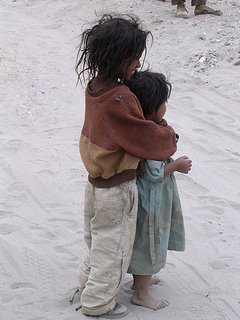
What does one derive from this? What does it mean in the 21st century to live amongst those who characterize themselves as “Civilized,” as the “First World,” as the “Free World,” a people sojourning through the world on a self-imposed mission to spread democracy, what does it mean to still have segments of this population embrace not only clandestinely, but openly the dehumanizing and devaluing realities of racism and classism? And what effect does that have on the worldview of someone who embraces the tenets of racism and classism? Did race and/or class play a role in the Hurricane Katrina catastrophe? Does race and/or class affect how we respond to the HIV/AIDS epidemic in Africa? Is it plausible that we need to reflect on what people and terminology we associate with poverty, child labor and trafficking, famine, child prostitution, and how that association affects our subsequent response, or the lack their-of?

I don’t know any of the answers to the aforementioned questions, rather I do know that in Addis I felt welcomed, I felt like I belonged, and I forgot about notions of “us and them” and thought in terms of “we”—their concerns became mine. Maybe those of us in the “First World” can learn from the *“Third World” and start viewing the world in terms of “we.” Plausibly from that reference point, for instance, we can refrain from viewing issues facing Africa as Africa’s problem, but rather as our problem, which would foster an inclusive worldview, rather than an exclusive one. A worldview that compels us to act: to act on behalf of the 1.2 million children trafficked each year, on behalf of the13 million children orphaned by AIDS, on behalf of the 1 million children globally confined to a life in detention as a result of conflict with the law, on behalf of the 246 million children engaged in child labor and the approximate 180 million forced into the worst forms of child labor, on behalf of the 2 million children exploited through prostitution and pornography, on behalf of the 300,000 child soldiers (some as young as eight) exploited in armed conflict, on behalf of the estimated 40 million children that suffer from abuse and neglect and lack health and social care, on behalf of the 100 to 130 million women and girls that have been subjected to some form of genital mutilation/cutting, and on behalf and in remembrance of the more than 2 million children that have died as a result of armed conflict since 1990.


* I do not advocate using “First World” and “Third World” terminology, however I think using such terms in this context helps to deconstruct these false notions of a "First" and "Third World."


Tuesday, March 14, 2006

Head-to-head: Africa's food crisis

This article details the contributory factors influencing Africa’s food crisis, as well as advances potential solutions to this deepening crisis.
Article Excerpts:
What are the solutions?
Political will to carry out what we know can halve hunger by 2015 and eliminate hunger altogether, including:
~Investment in Africa's agriculture and rural sector
~Dismantling of trade barriers and investment in African expertise to take advantage of trade opportunities
~Reducing malnutrition among mothers and children so that the generational cycle of poor nutrition and poverty is broken
~Improving and expanding basic education; the adoption of governance approaches that ensure accountability to citizens, including the vulnerable among them and empowering the African ~Union and other regional bodies to take responsibility for peace and security on the continent

“People are hungry because they are powerless and powerless because they are hungry. It's a vicious cycle. Drought can and does happen in other places; wars do happen with equal ferocity in other places. What turns drought and other natural or unnatural disasters into famine, chronic hunger, mass death, etc is the power relation between the victims and those who control, govern, rule or misrule them.”

In pictures: Somali drought


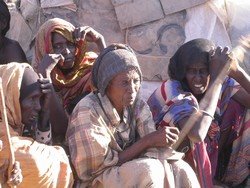
These visuals illustrate the plight of Somalia, one of the countries in the Horn of Africa most severely affected by drought, with an estimated 11.5 million people on the brink of starvation.

Monday, March 06, 2006

Time short in Kenya food 'crisis'

This article details the threat of starvation faced by 3.5 million people in Kenya and 11 million people across the Horn of Africa. The United Nations (UN) maintains the impetus for this food shortage was five years of drought in the region; however poverty reduction is the “underlying concern.” The article warns of large scale deaths do to malnutrition if the donation shortfall of $189 million dollars is not met. Additionally, 1.7 million people in Somalia are confronting food shortage as well. Dominic Nutt, emergency specialist for Christian Aid, asserts: “This is a crisis on the verge of becoming a catastrophe.” “There are dead cattle everywhere and people have sold everything they have to buy food.” “These are the last few weeks that many people are going to be able to survive without help.”

Sunday, February 26, 2006

Guidelines for Inclusion: Ensuring Access to Education for All

Via: Eldis
"This paper examines how excluded children are planned for in education. It provides guidelines and concepts for rendering National Education Plans / Education for All (EFA) more inclusive, with the objective of ensuring access and quality education for all learners. The guidelines are intended to provide information and awareness and to be a policy tool for revising and formulating EFA plans."

"The paper is divided into three main parts: it provides a theoretical framework which defines inclusion and explains how it is founded in a human rights approach and how it relates to factors such as quality and cost-effectiveness; it looks at more practical changes at the school level by outlining the key elements in the shift towards inclusion with a particular focus on the key players including teachers, parents and educational policymakers as well as curricula; and the final section presents tools for policymakers and educational planners for hands-on analysis of education plans. These include key questions to consider at the level of policy and legislation before engaging in an in-depth analysis of the educational plans and checklist questions from the Index for Inclusive Schooling indicators to help facilitate the process of identifying gaps and corresponding strategies to address these gaps and move towards inclusion."

Saturday, February 25, 2006

Orphans and Vulnerable Children

According to studies, by 2010 their will be approximately 25 million children worldwide orphaned by AIDS. This article highlights the complexity of providing effective care and support to orphans and vulnerable children infected and/or affected by HIV/AIDS. Orphans and vulnerable children face numerous burdens: stigma/discrimination, caring for ill family members, enduring impoverished households (poor nutrition and health care), and difficulties both psychological and emotional. Additionally, this article details lessons learned from various countries engaged in addressing the plight of orphans and vulnerable children.

Monday, February 20, 2006

Asnaka the future Professor!

PAPER JUST WASN'T FUN ENOUGH!


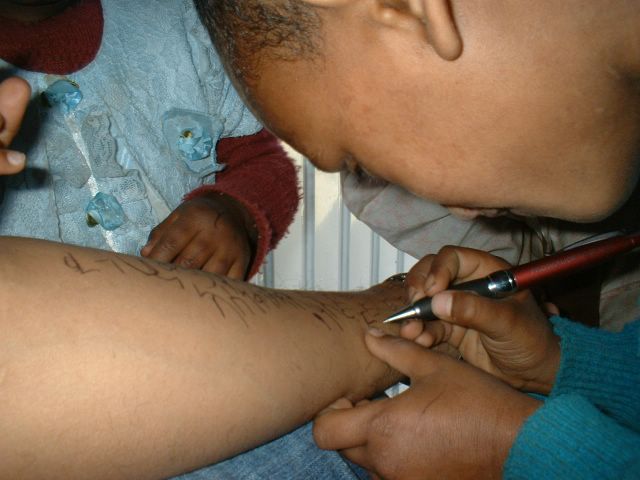
I asked, “What did you learn this week in school,” they emphatically replied, “Alphabets!” I asked them to show me, but I guess paper wasn’t fun enough!

Sunday, February 19, 2006

ETHIOPIA: Campaign launched against child trafficking

This article explores Child trafficking in Ethiopia and introduces a campaign launched by the Ethiopian government, United Nations (UN), and the International Organization for Migration (IOM) to highlight the plight of vulnerable children in Ethiopia. According to this report, Ethiopia has one of the highest rates of internal trafficking with an estimated 20,000 children sold annually by their family. Ethiopia has approximately 4.6 million orphans, and 200,000 children living on the streets of Addis Ababa, the capital of Ethiopia. Children trafficked are often engaged in domestic labour, commercial sex work, professional begging and other menial tasks. The IOM maintains that an estimated 10,000 Ethiopian women are trafficked abroad to the Gulf States for prostitution. The campaign entitled, “Ethiopia’s Campaign for Vulnerable Children,” seeks to encourage 2006 candidates running for local elections to advance this issue through their agenda.

Saturday, February 18, 2006

Awakening: Ambiguity Fosters Clarity

by: Nasir Al-Amin
Ethiopia was a moment of awakening. It brought the numbers to life; the figures (4.6 million orphans, and 200,000 children living on the streets of Addis) became tangible. The words (domestic workers, poverty, commercial sex workers, child labourers, orphans, under-five mortality rate, and beggars) were now faces, individuals that I built relationships with, people I ate and laughed with, people I hugged and lent a shoulder to in moments of sorrow. In essence, my reality had changed. My perspective and/or worldview was altered by the realty of others. The children and their families became the center. My life, rather my life’s purpose was no longer about me. And it was this shift that nurtured a dormant seed of discontent that subsequently, led to a year of isolation, self-reflection and reprioritization.

After I returned to the States, I would often isolate myself (at first unknowingly) from friends (especially my Ethiopian friends) and environments (Ethiopian restaurants and cafés) that at best reminded me of Ethiopia and at worst subjected me to that dreaded question: “How was Ethiopia?” As Ethiopia was no longer this tranquil place, an escape from America’s dominant culture and norms, a bastion of generosity and love, my on little gem, this utopia that the West had not conquered or found. Ethiopia (both figuratively and literally) in all it splendor had changed and I could no longer articulate this new reality. My life experiences, Columbia diction and education could not prepare me for the emotional component of my endeavor. The veil had been removed, and what I saw left me speechless.

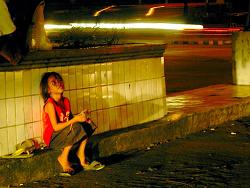
What words can speak to the reality of desperate girls walking the streets at night selling their bodies, or a teenage mother and her baby after a day of begging trying to sleep and stay warm on the sidewalk wrapped in tattered and soiled blankets—shockingly, often one sees groups of street children huddled together employing body heat as their sole means of staying warm. How does one express that somber feeling when children run to your vehicle at traffic lights placing their hands and faces on the car window with a dismal gaze begging for food or coins?

Unfortunately, for some Ethiopians living abroad and in Ethiopia, this reality has become normalized and thus they have become desensitized to the destitute and their plight. So much so that when they speak of Ethiopia and/or their trip back to Ethiopia the latter (destitute families and children) are not apart of the discussion—for instance, some will rave over the industrial improvements of Addis (which is laudable), yet fail to recognize that the conditions that give rise to street children, prostitution, child labour and exploitation have failed to improve. How do I reconcile these two worlds? How do I express to people that their $5-$10 dollar a week Starbucks addiction could change the life of a child begging on the streets of Addis, as this same amount of money could take a child from the streets into the classroom, and secure food, a school uniform and supplies. How do I convey to people that the cost of clubbing (and its associated cost: dinner, drinks…etc) two nights a week if collected at the end of one month, could prevent an uneducated and desperate girl from resorting to prostitution for a year.
TO BE CONTINUED…