Thursday, September 07, 2006

Awakening: Ambiguity Fosters Clarity (Re-Published)

Awakening: Ambiguity Fosters Clarity
by: Nasir Al-Amin
Ethiopia was a moment of awakening. It brought the numbers to life; the figures (4.6 million orphans, and 200,000 children living on the streets of Addis) became tangible. The words (domestic workers, poverty, commercial sex workers, child labourers, orphans, under-five mortality rate, and beggars) were now faces, individuals that I built relationships with, people I ate and laughed with, people I hugged and lent a shoulder to in moments of sorrow. In essence, my reality had changed. My perspective and/or worldview was altered by the realty of others. The children and their families became the center. My life, rather my life’s purpose was no longer about me. And it was this shift that nurtured a dormant seed of discontent that subsequently, led to a year of isolation, self-reflection and reprioritization.

After I returned to the States, for the first few months I isolated myself (at first unknowingly) from friends (especially my Ethiopian friends) and environments (Ethiopian restaurants and cafés) that at best reminded me of Ethiopia and at worst subjected me to that dreaded question: “How was Ethiopia?” As Ethiopia was no longer this tranquil place, an escape from America’s dominant culture and norms, a bastion of generosity and love, my on little gem, this utopia that the West had not conquered or found. Ethiopia (both figuratively and literally) in all it splendor had changed and I could no longer articulate this new reality. My life experiences, Columbia diction and education could not prepare me for the emotional component of my endeavor. The veil had been removed, and what I saw left me speechless.

What words can speak to the reality of desperate girls walking the streets at night selling their bodies, or a teenage mother and her baby after a day of begging trying to sleep and stay warm on the sidewalk wrapped in tattered and soiled blankets—shockingly, often one sees groups of street children huddled together employing body heat as their sole means of staying warm. How does one express that somber feeling when children run to your vehicle at traffic lights placing their hands and faces on the car window with a dismal gaze begging for food or coins?

Unfortunately, for some Ethiopians living abroad and in Ethiopia, this reality has become normalized and thus they have become desensitized to the destitute and their plight. So much so that when they speak of Ethiopia and/or their trip back to Ethiopia the latter (destitute families and children) are not apart of the discussion—for instance, some will rave over the industrial improvements of Addis (which is laudable), yet fail to recognize that the conditions that give rise to street children, prostitution, child labour and exploitation have failed to improve. How do I reconcile these two worlds? How do I express to people that their $5-$10 dollar a week Starbucks addiction could change the life of a child begging on the streets of Addis, as this same amount of money could take a child from the streets into the classroom, and secure food, a school uniform and supplies. How do I convey to people that the cost of clubbing (and its associated cost: dinner, drinks…etc) two nights a week if collected at the end of one month, could prevent an uneducated and desperate girl from resorting to prostitution for a year.
TO BE CONTINUED…

Thursday, August 10, 2006

Obstacles to Education

It cost $5 for one girl’s uniform and only $4 for one boy’s uniform!
In Ethiopia, school enrollment is based on a number of conditions. Two of these conditions are that students must have a school uniform and pay the tuition fee. Unfortunately, these conditions prohibit orphans and vulnerable children from poverty-stricken families from enrolling in school. Thus, one of the aims of Project FACE is to alleviate this barrier to education for orphans and vulnerable children.

A detailed breakdown of the cost associated with covering the cost of school uniforms, materials (an exercise book, pencils, and erasers), tuition fees, and backpacks are as follows:

School Support for Girls
Number of beneficiaries: 4
Uniform 1-girl: ($5.00) 4-girls: ($20.00)
Stationary: 1-girl: ($3.00) 4-girls: ($12.00)
Backpack: 1-girl: ($4.00) 4-girls: ($16.00)
Tuition Fee: 1-girl: ($3.00) 4-girls: ($12.00)
Total:
12-Months 1-girl ($15.00) 4-girls ($60.00)

School Support for Boys
Number of beneficiaries: 3
Uniform 1-boy: ($4.00) 3-boys: ($12.00)
Stationary: 1-boy: ($3.00) 3-boys: ($9.00)
Backpack: 1-boy: ($4.00) 3-boys: ($12.00)
Tuition Fee: 1-boy: ($3.00) 3-boys: ($9.00)
Total:
12-Months 1-boy ($14.00) 4-boys ($42.00)

Please join Alliance (http://www.allianceinvestment.org/) in affording orphans and vulnerable children in Ethiopia with the opportunity to attend school!

Tuesday, August 08, 2006

HOW YOU CAN INVEST IN THE FUTURE OF A CHILD!

Operating Expenses for 6-months and 12-months

Scholarship for Girls
# of participants: 4
6-months: $480.00
12-months: $960.00
Breakdown:
Daily 1-girl: ($0.66) 4-girls: ($2.64)
Monthly 1-girl ($20.00) 4-girls ($80.00)
6-Months 1-girl ($120.00) 4-girls ($480.00)
12-Months 1-girl ($240.00) 4-girls ($960.00)

Scholarship for Boys
# of participants: 3
6-months: $360.00
12-months: $720.00
Breakdown:
Daily 1-boy: ($0.66) 3-boys: ($1.98)
Monthly 1-boy: ($20.00) 3-boys: ($60.00)
6-Months 1-boy: ($120.00) 3-boys: ($360.00)
12-Months 1-boy: ($240.00) 3-boys: ($720.00)

School Support (girls)
# of participants: 4
6-months: -
12-months: $52.51
Breakdown:
These funds are for school uniforms for 4 girls. In Ethiopia a child can not attend school if he or she does not have a school uniform.

School Support (boys)
# of participants: 3
6-months: -
12-months: $35.95
Breakdown:
These funds are for school uniforms for 3 boys. In Ethiopia a child can not attend school if he or she does not have a school uniform.

Total Support (including Scholarship and School Support):
# of participants: 7
6-months: $840.00 ($480.00 + $360.00)
12-moths: $1,768.46 (960.00 + $720.00 + $88.46)

Tuesday, August 01, 2006

FAMILY AND CHILD ENRICHMENT PROGRAM (FACE)--ETHIOPIA

PROJECT FACE:

CASE STATEMENT
In Ethiopia, formal education is restricted to families that can afford the cost of uniforms, school materials, and books. For the 150,000 to 600,000 child laborers living and working on the streets of Ethiopia, obtaining a formal education is a faint possibility.One of the fundamental causes of child labor is extreme poverty. Poor families in Ethiopia like in other developing countries, engage their children in child labor in order to confront the immediate impact of poverty—the inability to secure basic necessities such as food, shelter, clothing and medicine. In essence, the child's economic contribution is vital to the survival of impoverished families.

Poor parents are cognizant of the fact that educating their children would increase their future earning potential and standard of living, yet poverty-stricken families are unable to afford the “luxury” of forgoing their children’s contribution to the family income. Subsequently, a conflict evolves between the short-term economic interests of the family and the long-term interests of the child.In response to this conflict and the increasing number of children who have their right to education denied, the Family and Child Enrichment Program (FACE) was created.

MISSION OF FACE
The mission of FACE is to ensure that orphaned and vulnerable children (OVC) from poverty-stricken and HIV/AIDS affected families have sufficient means and resources to complete their education, as well as to ensure these families have the proper financial assistance to confront the immediate impact of poverty.

OUR APPROACH
Under FACE monetary assistance is provided in the form of a monthly scholarship to OVC from poverty-stricken and/or HIV/AIDS affected families. These families with school age children (4 to18 years old) are allocated scholarships on the condition that their children are enrolled in school, maintain a monthly attendance of 90%—(no more that 2 absences per month), and go for periodic medical check ups. The purpose of the scholarship is threefold:
1. To defray the short-term impact of poverty: the inability to secure basic necessities such as food, shelter, clothing and medicine;
2. To off-set the opportunity cost of sending children to school—the value of work the child would perform if he or she were not in school;
3. To defray the indirect costs imposed on poor families—school supplies, school uniforms and transportation.

Consistent with our aim to empower women, participating families will have an account opened in the mother’s name, so that the monthly scholarship can be distributed directly to the mother’s account. Empirical research (IFPRI Perspectives, 2002) indicates that “when women control assets, expenditures on children’s education increase and the rate of illness among girls drops.”FACE beneficiaries are provided with a uniform and school supplies, in addition to having their registration and tuition fees covered. The monthly amount of the scholarship is 174 Ethiopian Birr ($20) for both girls and boys.

To learn more and/or get involved with Project FACE go to www.allianceinvestment.org

Monday, July 31, 2006

PHILANTHROPIC CONTRIBUTION

I would like to acknowledge the philanthropic contribution of Fuad Musa. After my speech at 2006 Badr Conference Fuad approached me and on behalf of his company, FuFu Products, he donated 40 beautiful mugs with the simple condition that all the proceeds go to the orphans and vulnerable children I work with in Ethiopia. Due to his altruism and the compassion of the Ethiopian Muslim community, I was able to raise enough funds to support two of the kids in Project FACE for a year.

The children I work with through Project FACE are kids who have lost one or both of their parents to HIV/AIDS, children who are engaged in child labor, children who have inherited a life of poverty, children with limited opportunities for the future. Fuad’s support will allow me to help these children secure their most basic needs: food, clothing and shelter.

Fuad and those who purchased the mugs are an inspiration and exemplify the generosity needed to affect change in the lives of some of the Ethiopia’s most vulnerable children.

Please accept my sincere gratitude,
Nasir Al-Amin

Sunday, July 30, 2006

BADR CONFERENCE

BADR CONFERENCE:SPEAKING ENGAGEMENT
I would like to give my sincere appreciation to the First Hijrah Foundation (FHF) for affording me the opportunity to speak about the plight of Orphans and Vulnerable Children (OVC) to the Ethiopian Muslim communities of North American and Canada that convened in Vienna, Virginia for the 2006 Badr Conference. I hope that I was able to convey the realities of vulnerable children and inspire the community into action!

Sincerely,
Nasir Al-Amin

Thursday, July 27, 2006

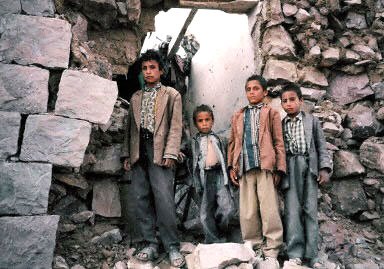
Yemeni children smuggled to Saudi


VIA: Middle East Online

Poverty-stricken parents encourage trafficking of their children from Yemen to Saudi Arabia to work as beggars.
By Christian Chaise - SANAA
Misery in Yemen continues to encourage child trafficking into Saudi Arabia, with widespread cases of parents paying smugglers to take on their offspring to work as beggars on the streets of the oil-rich neighbour. Thousands of children, as young as seven and including girls, continue to be entrusted by their parents to traffickers who help the youngsters cross the desert borders illegally into Saudi Arabia, UN officials said. The children, who mostly come from large and poor families, sweat to earn money through small, menial jobs or most often by begging on the streets. Thousands of them are regularly caught by Saudi police and sent back home.
Trafficking mostly feeds on extreme poverty in northern Yemen, particularly in the province of Hajjar which is close to the Saudi border.

"Now families are paying smugglers to take their children to Saudi Arabia," Ramesh M. Shrestha, a representative of the United Nations Children's Fund (UNICEF), said. "We've heard of agreements between traffickers and parents with government officials as witnesses to make sure the traffickers will pay," he said. He said "each kid is sending 200 to 500 dollars to their family each month," in a country where annual revenues per capita are just a bit more than 500 dollars. The alarming situation has prompted UNICEF and the Yemeni ministry of social affairs to organise the country's first conference on the subject in Sanaa in January. It was the first time that Yemeni authorities officially admitted the problem, most probably because it constituted negative publicity for the country.

Prime Minister Abdel Kader Bajammal however still insists that trafficking of children - words that authorities do not like to use to refer to the problem - involved only "cases, not (a) big quantity." Shrestha also said that the situation was even more complicated by the fact that many children were also illegally brought into Saudi Arabia from Yemen by their own parents.
In the first quarter of 2004, more than 150,000 Yemenis, including 9,815 children, were expelled from Saudi Arabia. The number of those who were victims of trafficking however is not known. Most of the Yemeni children smuggled into Saudi Arabia were boys aged between 10 and 16, said Shrestha.

The Yemeni Centre for Social and Labour Studies said in a study that "the child trafficking problem is one which, though it did not originate at that specific time and might be very old, became significant as a result of the Gulf crisis (war) of 1990-91." "Due to the opposition of the Yemeni government to the Saudi cooperation with America and the allies against the Iraqi regime of Saddam Hussein, Saudi Arabia repatriated many Yemeni migrant workers and since then, there has been greater difficulty in legally obtaining employment in Saudi Arabia," it said.

Shrestha said that another main hurdle obstructing efforts to curb the problem is that "in Yemeni criminal law, there is no mention of trafficking of human beings. So it is not legal or illegal." "Even when traffickers are caught, they are released, because it is not illegal," he said, calling for legal amendments. Shrestha said that another main problem that encourages the trafficking of children is the miserable state of the educational system. School may be mandatory in Yemen, but only 80 percent of children actually enroll. With half of the 20 million population under 18 years old, Yemen only has 13,000 schools, among them 800 for girls.
"I am really not so sure what is feasible in the short term and in the long term," added Shrestha.

Tuesday, July 25, 2006

More than 600 children die every day

VIA: CNN World

Report: Congolese children bear brunt of war LONDON, England (AP) -- More than 600 children die every day in war-ravaged Congo and even more are displaced, sexually abused and swept up into the camps of combatant groups, according to a UNICEF report released Monday.
Martin Bell, a former war correspondent and UNICEF ambassador, wrote "Child Alert: Democratic Republic of Congo." The report was released less than a week before the country's elections, the first democratic ballot in more than 40 years.
"It is easy to be overwhelmed by what has happened in DRC [Congo] because of the sheer scale of it," Bell said. "But we owe it to the children to give them the future they deserve. ... These elections may be the opportunity of their lifetime." The United Nations is helping organize the July 30 vote, the biggest elections the world organization has ever undertaken. Its biggest peacekeeping force of 17,600 troops and a recently arrived European Union force of 1,000 soldiers are deployed to maintain calm at 50,000 ballot stations, scattered across a country the size of Western Europe with only a few hundred miles (kilometers) of paved roads.
Thirty-three candidates are running for president and 9,000 for legislative seats, but many are asking to have the campaign suspended until charges of campaign cheating, backed by several human rights groups, are investigated.
Bell presented the report in central London with Tony Bloomberg, UNICEF representative for Congo, at the University of London's School of Oriental and African Studies.
The two discussed bolstering support for education and schools, which UNICEF sees as a path to reintegrate child soldiers and molestation victims as young as 6 back into a stable community.
"The role of the school here is very important -- a normalized school environment not only helps the child in terms of trauma, but it also gives them a tool for the future," Bloomberg said.
"It gives them hope."
UNICEF estimates Congolese rape and sexual assault victims number in the hundreds of thousands -- epidemic proportions because of combatant groups deploying sexual violence as a weapon of war.
"They [children] are caught up in war as refugees and internally displaced people: Constant migration robs them of schooling, health care and the chance for a normal life," the report says. "And they are caught up in combat as soldiers and camp followers."
Young girls are singled out for sexual crimes, the report states, due to false beliefs that having sex with them will cure HIV/AIDS.
An estimated 1.1 million people now live with the disease in the Congo -- a number UNICEF says will only climb as war, gang rape, genital mutilation and community displacement continue to wrack the country.
The report also states that
more children under the age of 5 die every year in Congo than in either China -- a country with 23 times the population -- or in all the Latin American countries combined.
"Children bear the brunt of conflict, disease and death, but not only as casualties," Bloomberg said. "They are also witnesses to, and sometimes forced participants in, atrocities and crimes that inflict physical and psychological harm."

Images of the Most Vulnerable

Via: CNN


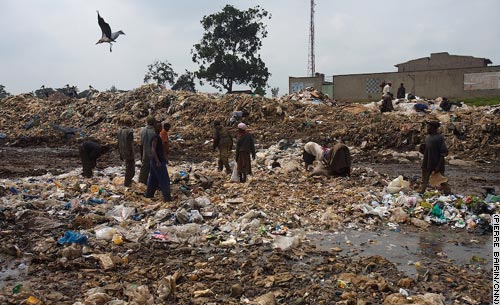
People and vultures compete over scraps in the main garbage dump of Nairobi, Kenya.


There are more than three million people in Kenya infected with HIV/AIDS, and more than two million have died of AIDS-related complications, according to Kenya's National AIDS Control Council.


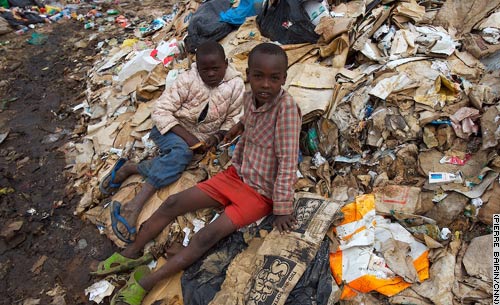
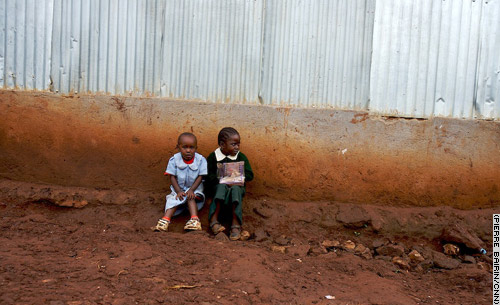
The people who live in Nairobi's slums often collect plastic bags from the dump and sell them for a few cents.


Fatma prepares food for her husband, Hussein, who is dying of AIDS, while their 11-year-old son Mukhtar watches. Fatma also is infected with AIDS.


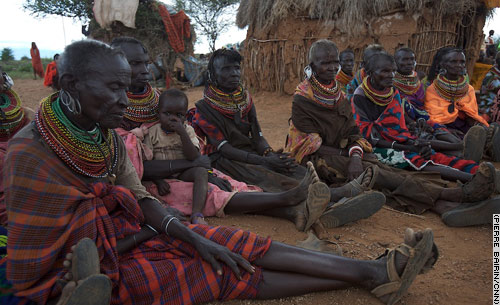
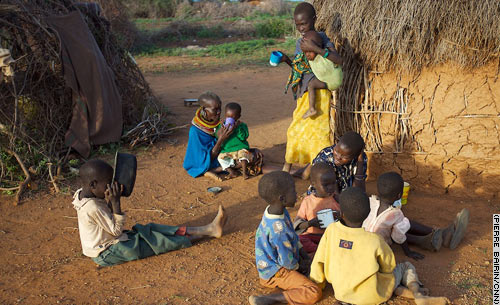
There are as many as one million AIDS orphans in Kenya, and grandmothers are often the only ones left to care for the children. The disease has destroyed even indigenous communities deep in the Kenyan countryside -- such as the Masai community shown here.


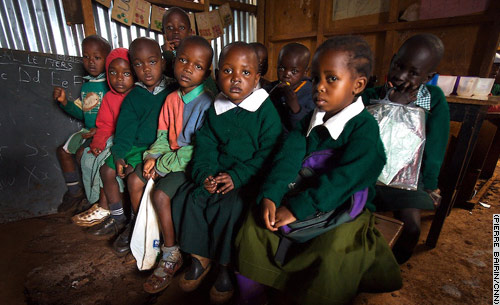
Children sit in class at the Stara Rescue School in the Kibera slum of Nairobi, Kenya. Of the 470 children in the school, approximately 70 percent are AIDS orphans.


Masai grandmothers struggle to find food for their orphaned grandchildren.


Many AIDS orphans are themselves HIV positive.

Saturday, July 22, 2006

World fails to save Africa's AIDS orphans

Via: CNN

ISIOLA, Kenya (CNN) -- AIDS invaded our consciousness 25 years ago. A whole generation around the world has now grown up knowing only a world with AIDS. We have watched the efforts to find a vaccine, to find drugs to control the disease, to educate people about preventive measures, and to end the stigma of AIDS. There have been many successes in helping adults with the disease, but when it comes to the children, the world has failed dismally.

Millions and millions of AIDS orphans are the devastating legacy of this epidemic. Africans suffer the most. According to the United Nations, there are 12 million AIDS orphans in sub-Saharan Africa alone, and in four short years that number will skyrocket to 18.4 million. That means AIDS orphans will make up 15 to 20 percent of the population in some African countries.
Traveling around the region, we met young children heading entire households, after losing one or both parents. Because the adults are missing, entire economies are collapsing. There's no one left to plant crops, tend livestock or look after the young. And AIDS is killing the children as well.
According to the United Nations, HIV infection is more aggressive in children less than 18 months old than in adults. In the absence of any treatment up to 50 percent of HIV-infected children die by their second birthday. In Africa, less than 5 percent of HIV-positive children who need treatment have access to it. And every day, another 1,800 children are infected with HIV, mostly at birth or from their mother's milk.


In Europe or America, this is almost unheard of because there is effective treatment to stop pregnant mothers from passing on the virus to their newborns. But in Africa, there is little access to this life-saving prenatal therapy. Furthermore, only 10 percent of pregnant women in Africa have access to basic treatment that could half the rate of transmission of HIV to their newborns. "It's another grotesque double standard," said Stephen Lewis, the U.N. AIDS envoy to Africa.


'It's everybody's fault'
Ninety percent of all HIV-positive children under 15 are infected mainly through mother-to-child transmission, according to UNICEF's global figures. Special pediatric AIDS drugs have only been made for children in the last two years.
We asked Dr. Chris Ouma, UNICEF's AIDS specialist in Kenya, why children have gotten such a raw deal.
"I think it's everybody's fault really," he said. "We were slow on the science. We did not speak out for them. Companies did not see the incentive to invest in drugs for children as there's no one to pay. And all this has now resulted in an unacceptable death [rate]."
He added, "I think now as technology brings out superior drugs, things are starting to change. It's 10 years too late, but at least something is being done now."
Indeed Kenya is one of the countries that has made a significant dent in AIDS prevalence and treatment. But there still is much more to do. There are currently one million AIDS orphans in Kenya alone. UNICEF reports that around the world, there are about 2.3 million children under 15 living with HIV. Two million of them live in sub-Saharan Africa, or 90 percent of the world's HIV-infected children.


Grandmothers increasingly raising orphans
Our journey took us from Isiola and the rural tribes in northern Kenya to Kibera just outside Nairobi. Kibera is the world's largest slum, where 50,000 AIDS orphans scratch out a living.
There we came across the amazing phenomenon of African grandmothers -- a whole generation of elderly women now looking after their grandchildren, after the mothers and fathers died of AIDS. Without them, these vulnerable children would be dead, or turn to a young life of crime and prostitution.
In Isiola, where Kenya's paved road to Ethiopia and Somalia ends, the incidence of HIV is almost double the national average, and it's due to the convergence of truck routes and tribal traditions. The drought and famine that recently hit this part of Kenya exacerbates the AIDS and health crises. Tribesmen told us the appalling story of sending their wives out for prostitution, in order to afford food. But along with the food, they bring AIDS back to their tribe and their village.


Motor bikes get drugs to remote areas
However, all is not bleak. In the shadow of Mount Kilimanjaro on Masai tribal lands, a team of local doctors and community health workers is bringing 21st century medical care to rural Africa. American philanthropist Anne Lurie, who is also a pediatric nurse, has planned and paid for the AID Village Clinic here, along with its sophisticated medical equipment and highly trained Kenyan doctors. For the Masai villagers, all the treatment is free.

What makes this clinic truly remarkable, though, is the outreach. Doctors don't just sit and wait for patients, they go out and find them, treat them, and make regular follow-up calls.
The outreach project is the brainchild of two British dirt bikers, Barry and Andrea Coleman, who realized that a transport network was the missing link. "The entire continent of Africa is more or less grounded when it comes to health outreach. Which is a pretty big problem when you think of the effort that goes into sending drugs, sending health care expertise and it all doesn't reach the people who need it," said Barry Coleman. Without any government help, they've sent hundreds of motor bikes to Africa's wildest places with money they've raised at bike rallies in England. They have also trained the local health workers how to drive and maintain them.
It seems to be making a difference in Africa's medical catastrophe. The Colemans have similar and bigger bike outreach projects in Gambia and Zimbabwe, and doctors there tell them that they are having an effect on reducing the disease and illnesses by getting patients much-needed medicine. He said more such programs are urgently needed: "People are just dying for absolutely no reason at all."

He told us that the project we saw in the Masai country could be replicated around Africa. With so much money being poured into AIDS research and government coffers, perhaps one solution is to seek the simple effective approach. It does work. In the heart of rural Africa, we saw one pregnant mother infected with HIV who got the right prenatal drugs and did not pass on the virus to her son. One life saved, one child saved from becoming another African AIDS orphan.

From child slave to film director

Via: The Age

Andra Jackson
July 10, 2006
THIRTEEN-YEAR-OLD internationally acclaimed children's film director Sahiful Mondal draws on his early experience of slave labour in making his latest film, The Inner Eye.
Sahiful is one of more than 500 children rescued from child labour by Swapan Mukherjee, founder of Muktaneer (meaning Open Sky), a home for destitute children in Kolkata. In Melbourne to speak to schoolchildren, the young director described The Inner Eye as a parable about indifference and cruelty."When we were hungry, the masters were eating, but they had not the eyes to see that we were hungry," said Sahiful, who was put into servitude at the age of four.

His father had died and his destitute mother, two sisters and a brother had ended up living in a roadside hut made of bamboo, plastic and leaves.
He worked nine hours, seven days a week as a dishwasher in a household where he was beaten for breaking a glass. He was "paid" a bowl of stale rice a day, which he shared with his mother.He also did back-breaking work crushing mud with a brick for which he earned the equivalent of 20 cents a day.His last job was goat herding, for which he earned two portions of stale rice a day.

"One day I couldn't find a goat and I came back and told my master and they didn't give me and my mother food for two days and I was beaten," he said.
He was seven when taken into Muktaneer. There he received four meals a day, slept in a bed and was allowed to play for the first time.

Sahiful is one of 40 boys who live at Muktaneer, the house Mr Mukherjee set up during the devastating floods of 1978 that left many homeless. Some of the children had worked as slaves, while others had been kidnapped and sold.
Mr Mukherjee is the secretary of the Centre for Communication and Development in Kolkata, which runs Muktaneer, its own school and physiotherapy centre and 65 schools in West Bengal villages.

He is in Australia to establish links with educational and medical organisations and appeal for more volunteer teachers, after the Melbourne-based Friends of Kolkata attracted 18 volunteers. It is also helping build a new English-medium school and a girls school.Sahiful's fascination with Mr Mukherjee's video camera led to the idea of boys making their own films.

His first effort, I Am — about the boys' dreams — won the Grand Prize at the 2004 International Children's Film Festival in Athens. His second film, We Are, won the festival's 2005 Grand Prize. This year, he attended the festival in Cyprus, where The Inner Eye won second prize.The bright-eyed youngster's ambition is to make films in the tradition of the great, socially insightful Indian film director Satyajit Ray to "help people".

Friday, July 14, 2006

Understanding Child Labor, Patterns, Types, and Causes

The following is a summary of the article: Understanding Child Labor, Patterns, Types, and Causes
Via: eJournal USA

Summary:
UNDERSTANDING CHILD LABOR
by: Nasir Al-Amin
In the article Understanding Child Labor, Patterns, Types and Causes, by Eric Edmonds, child labor is viewed as a facet of poverty, in which emphasis is placed on addressing a family’s inability to secure their most basic needs. This financial constraint leads destitute parents to face the “difficult decision” to either engage their children in the informal labor market or to invest in their children’s future by sending them to school. The economic contribution of children is vital to poor families living standards and their ability to cope with extreme poverty. However, a family’s decision to engage their children in child labor is not exclusively driven by a family’s impoverished state.

Furthermore, during this decision-making process, parents must also asses the value of their child’s time against the opportunities afforded the child. Parents will not opt to forego their child’s economic contribution if the alternatives to child labor are not attractive enough. Another influential factor is a families ability to access credit. Households that are able to borrow against future earnings are able to allocate these funds to schooling expenses such as textbooks, uniforms and school supplies.

The later section of this article looks at polices aimed at eliminating child labor. Vital to effective policy is that it eliminates the need for child labor, rather than simply eliminating employment options for children. Interventions that have been effective are programs that pay children a stipend for attending school. Oportunidades, one such program operating in Mexico, has assisted five million families. Essential to Oportunidades effectiveness is its ability to mitigate the impoverished family’s need for their child’s financial contribution.

Child labor is pervasive and destructive to children’s health and development, as well as their ability to break the generational transmission of poverty. Thus efforts to address their plight must be grounded in a sound understanding of the various facets of child labor and seek to redress the poverty and environmental factors that cultivate child labor.

Tuesday, June 13, 2006

Lalibela Project: Reception, Art Show and Auction

Thomas Kocsis

Founder and Director of the
Lalibela Project
cordially invites you to a Reception, Art Show and Auction

Thursday, June 15, 2006
6:00 pm to 9:00 pm
Hospital Audiences, Inc.
548 Broadway, 3rd Floor
New York, NY

Entrance Fee: $30.00
(Proceeds will benefit the Lalibela Project)

We request the favor of an RSVP
by returning the enclosed card or going to
www.lalibelaproject.org/RSVP.html


The vision of the Lalibela Project is to create possibilities for children in an environment that will spark an epidemic of empowerment resulting in extraordinary life-altering experiences. The Lalibela Project, a non-for-profit organization, aims to develop and support an orphanage center in the village of Lalibela, Ethiopia. Providing housing and education will broaden these children’s perspectives and encourage them to dream.

Monday, June 12, 2006

1 in 7 Children Worldwide Work To Survive

Via: eJournalUSA


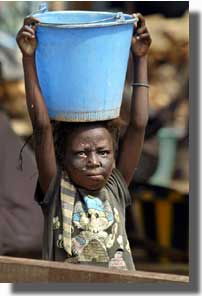
Seven-year old Catherine, her face scarred in a cooking accident, carries a bucket of water at a refugee camp in western Côte d’Ivoire. She was forced to flee her home during fighting over land on which to grow cocoa.

Text and pic provided by: Ben Curtis, AP/WWP

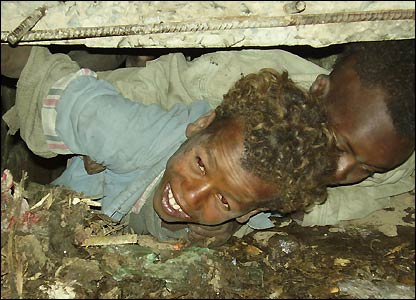
In pictures: Underground children (Ethiopia)

Via: BBC
The following is a dipection of street children in Addis Ababa Ethiopia, retrived from the BBC's section: In Pictures.

In hiding
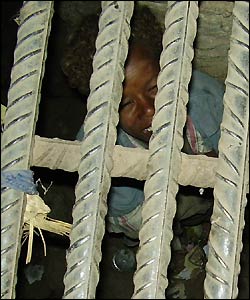
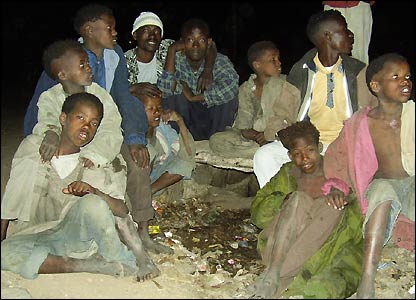
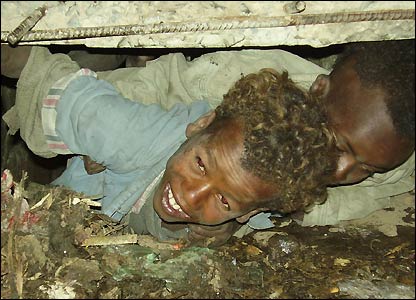
Blink and you will miss the underground children in Ethiopia's capital city. They live in tunnels, sewers and drainage holes, hidden beneath Addis Ababa's teeming streets. They move from one makeshift shelter to the next, chased away by police or the rivers of water and refuse that flow when the rains come. Growing up amidst the traffic, they learn to hustle at a young age seeking change or selling small items to drivers at traffic lights.


Hidden
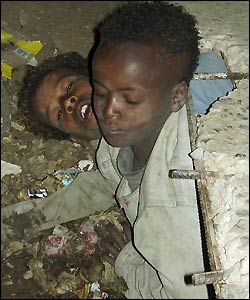
Across from the main post office, there is a sewage drain. It draws little attention. Thousands of people walk across its steel bars every day without giving it a second thought. This is good for Mohammed and his friends. They do not want their home to be discovered. The space is not more than half a metre high, and though it is five or six metres long, only one small portion is covered and unexposed. When it rains, the boys huddle together among the rubbish and waste.


Crowds
Encountering the street kids who live underground is not easy, but once we talked to a few, dozens appeared. As we walked in the shadow of the city’s main buildings, the children emerged from dark side streets and from nowhere at all. Soon we were surrounded by boys.


Hustle
For the children who have found shelter, however destitute and impermanent, the difficulties truly begin when they come up from underground and face the realities of their daily life. They must hustle for food scraps, avoid police, and beware exploitation and abuse. Many children perform odd jobs for restaurants and cafés to get bread and leftovers. Sometimes shelters will give out food, and there are soup kitchens that serve cheap meals.

Hana
There are fewer girls but they are there. Hana, a 15 year-old, comes from Ziway, a town south of Addis. She left home and came to Addis after an incident in which she accidentally lost her family's cattle and feared her father’s rage. She hopes to return one day. "Here you don't have much to worry about," she said.
"If you get something to eat, that is good. When you don't have any, you pass the time either sleeping or chatting with friends."


Sex
When they do have money, from begging or doing odd jobs, Hana and her friends often go to the cinema. One of the girls described her attitude to sex. She said that to be safe from both pregnancy and HIV/Aids she always uses a condom. She claimed she did not face serious dangers in this regard, and said no-one had ever forced her to have sex.


Henok
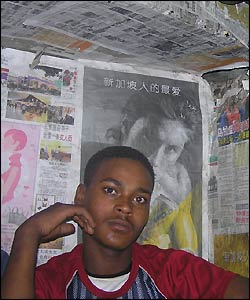
Henok Tesfaye came to the streets when he was 11 years old after losing his parents in a car accident. Ten years on, he is used to life on the streets. He lives beneath a main road in an unused hole dug for telephone cables. The roof is made of concrete blocks placed side by side across a small opening. To keep rain out, Henok and his roommate spread plastic sheets underneath old windscreens. A small hole is both the door and the window to their tiny home.


Numbers
Among the reasons for the high numbers of street children in Addis Ababa are extreme poverty, hunger, violent conflict and drought in rural areas. Often, the children come without families, orphaned by disease, escaping abusive and neglectful parents, captivated by tales of wealth and opportunity in the big city. An exact number is too difficult to pin down accurately, but various estimates put the total number of street kids in Ethiopia between 60,000 and 150,000.


Dawit
As we were talking to Dawit, 12, he eyed a rubber wristband and we gave it him, but the next day it had gone. “It was stolen last night,” he said, crestfallen. “When I was sleeping, someone grabbed my neck and started choking me. They said: ‘Give it to me or I’ll take your life.’ So I gave it them.” He shrugged his shoulders and walked off with a friend down the busy street - unnoticed.


Text and pictures: Will Connor and Mesay Berhanu

Tuesday, June 06, 2006

Ethiopia: HIV Prevalence Among Women Reaches 5 Percent

Source: allAfrica
Summary by Nasir Al-Amin

ETHIOPIA SEES A RISE IN PREVALENCE AND INFECTION RATE AMONG WOMEN
Globally, Ethiopia has one of the largest populations infected with HIV. Conservative findings indicate that nearly two million people in Ethiopia are living with the virus; however, non-governmental organizations (NGOs) contend that the number is over three million—at the national level, the prevalence rate of infection is 4.4%. (allAfrica, 2006) According to the Ethiopian Ministry of Health (MoH), the country has observed a rise in the infection rate among women, as well as a rise in the HIV/AIDS prevalence rate among women, which is presently at 5%. (allAfrica, 2006) In Ethiopia, like other developing countries, women’s health and child survival are place at greater risk given the presence of both HIV/AIDS and poverty. In an effort to curtail the spread of HIV in the country, the government of Ethiopia, established a free ART initiative that since its inception in January 2005, has serviced 35,000 beneficiaries, of which 46% were females and 4% are children. (allAfrica, 2006)

In order to read the article click the link: Ethiopia: HIV Prevalence Among Women Reaches 5 %

Monday, June 05, 2006

Two in Five Children Work


Via: IRINnews
Summary by: Nasir Al-Amin

In sub-Saharan Africa, nearly 50 million children aged five to 14 are engaged in some form of child labour, contends the United Nations Labour Organization (ILO) in their report ‘The End of Child Labour: Within Reach.’ According to Yaw Ofosu, an ILO child-labour specialist, sub-Saharan Africa presents an amalgamation of both success and set-backs in the fight to end child labour: the proportion of child labourers declined from 28.8 percent to 26.4 percent, however, the absolute number of child labourers increased to 49.3 million from 48 million. Influential factors that obstructed progress are extreme poverty, high population growth, and the HIV/AIDS pandemic, maintains Ofosu.

The continent of Africa is home to 50,000 children “engaged in commercial sex and pornography, and some 120,000 children under age 18…coerced into taking up arms as child soldiers, military porters, messengers, cooks or sex slaves.”(IRIN, 2006) Thus, globally Africa has the highest rate of children engaged in laborious activities. “What is crucial is policies that help poor families send their kids to school,” said Ofosu.

Friday, June 02, 2006

"Spark the mind that will change the world."

By: Nasir Al-Amin

"I may not be able to change the world, but I guarantee that I will spark the mind that will change the world." (Tupac)

Yesterday, I had the pleasure of being a panelist at Millennium High School’s career day fair. I was pleasantly surprised as I arrived at Millennium, situated in Wall Street, I noticed some students were having a canned food drive. Engaging youth in acts of social welfare is vital to nurturing the seeds of civic responsibility. This was the aim of my presentation, to convey a message that regardless of the profession they choose, they should look to see how their career, skills, talents and creativity could be used to affect change in the world.

During one segment I inquired if any of students could guess the number of children engaged in child labor globally? I received a number of figures, with the highest being 2 hundred million. They were shocked when I informed them that there are approximately 246 million children engaged in child labor. Ultimately, any time I’m afforded the opportunity to speak, it’s really an opportunity to raise awareness about the plight of orphans and vulnerable children. In the words of Tupac:
"I may not be able to change the world, but I guarantee that I will spark the mind that will change the world."

Below are EXCERPTS from the speech I delivered:

ADVANCE OPPORTUNITY IN THE LIVES OF OTHERS, BECOME AN AGENT OF CHANGE
By Nasir Al-Amin
I’m honored to have the opportunity to speak to you today.

I am here today because:
AIDS has rendered an estimated 13 million children orphans. By 2010, approximately 25 million children will have lost one or both of their parents to AIDS.

I am here today because:
Globally an estimated 246 million children are engaged in child labor, and each year approximately 1.2 million children are trafficked, and annually“over a million children enter the sex trade.”

I am here today because:
Half a million children in Ethiopia die each year from malnutrition and disease

So my purpose is to awaken in all of you the spirit to dream, create and persevere. To encourage you all to choose a path in life that will affect change in the world. Whether it’s a domestic or international issue such as HIV/AIDS, Child Labor, Child prostitution, parity in education and the health care system, or issues of racism and discrimination, choose an issue, saturate your mind and heart with information about those adversely affected by that particular issue and strive to affect change.

This brief outline is in essence, is the blueprint to my life: a life that enjoys both ease and hardship, but respects the necessity of both. A life that is a success, as I define success—not as popular media or the norms of this society defines success. Which leads me to my second point that I want to leave you with: Define for yourself what a successful life is, and constantly reflect and redefine your definition. The point is to remain the author, the definer.

So the two salient points I want to leave you with are the following:
1. First, educate yourself about an issue you have a passion for. Then dream, create and persevere.
2. Define for yourself what a successful life looks like.

For myself, my passion is aiding orphans and vulnerable children, specifically in Ethiopia. Additionally, I define a successful life as merely the culmination of successful days and a successful day is one in which I’ve made efforts at alleviating the suffering of others.

In closing, as future agents of change, I pray that you all are successful in your endeavors and that the world will benefit from your dreams, creativity and perseverance.

Tuesday, May 16, 2006

Ethiopian girls fear forced marriage

Via: BBC
“Parents don't have money for their children to go to school so they prefer for them to be abducted and married” (Elleni Mamo,Unicef)

Daily, vulnerable girls are “terrified” about walking to and from school, markets, and other locations out of fear of abduction. By the age of 13, Mulu Melka had escaped abduction twice, as she is one of many vulnerable girls in Ethiopia susceptible to marriage by abduction. Mulu’s story highlights this horrendous practice, which is a “widespread problem in Ethiopia.” This article contends that in one region of this East African country, an estimated 92% of all marriages are by abduction. Mulu’s last abductor was a 39-year-old suitor that she refused to marry, who subsequently, with Mulu’s parents consent kidnapped her. The article also explores the experience of Aberash, another girl captured, beat, raped and forced to marry. Strikingly, after Aberash escaped, she was forced to return to her husband by her parents and the local court. According to this article, poverty is an critical factor in abduction: "If they marry the girl legally they have to pay a lot of money to the parents of the girl but when it is abduction they take her by force then the elders intervene to mediate and they pay a very little amount of money or cattle to marry the girl." Poverty-stricken families that can not afford to send their children to school prefer marriage by abduction. Also, men resort to kidnapping when parent’s reject their request for marriage.

Event to Celebrate Ethiopian Women Champions

Via: SAHA
You are cordially invited
to celebrate Ethiopian women who have championed the cause of poor communities and their fight against HIV
Sr. Zebider Zewdie
The founder and executive director of Mary Joy Aid through Development, a non-profit no-governmental indigenous Ethiopian organization.
Berhane Kelkay
who is a pioneer in effectively and successfully inspiring women across Ethiopia. She lives with HIV, has formed organizations across the country of people living with HIV now has moved to include all women in "positive living."
These two champtions will be the guest speakers.

Discussion
1. Ethiopian women’s role in addressing HIV: present and future
2. Sustainability of current efforts and the business community

Sunday, May 21st, 2006

Meet Sr. Zebider from 2:15 pm to 2:45pm
Presentation from 2:45pm to 3:30pm
Discussion from 3:30pm to 4:00pm

The Theatre
Harlem School of the Arts
645 St. Nicholas Avenue
New York, NY 10030

RSVP by May16th
(917) 406-0480
Email asqualg@aol.com


Event is free but donations can be made at the event or through SAHA
Columbia University Station
P.O.Box 25001
New York, NY 10025

The World Bank: Hazardous to Africa’s Health

Via: Africa Action

"This newly-updated fact sheet argues that the policies imposed by the World Bank on African governments have devastated Africa's health care systems and fueled the fire of HIV/AIDS..."

ARTICLE EXCERPTS:
What does the World Bank do in Africa?
The World Bank uses conditions attached to its loans to effect economic policy changes in African countries. These changes cut back government services to the people, reduce trade barriers, and maintain economies as sources of cheap raw materials and cheap labor for multinational corporations. The results have been a decline in average incomes, worsening conditions of poverty, and an increase in Africa's foreign debt. Africa Action estimates that, between 1970 and 2003, African countries received about $540 billion in loans, and paid back $580 billion in debt service, yet the continent is still saddled with over $200 billion in external debt. The current debt relief framework – the Heavily Indebted Poor Countries (HIPC) Initiative – has proven to be an inadequate response to Africa’s debt crisis. Even the debt cancellation deal reached at the 2005 “Group of 8” summit is insufficient to address the continent’s debt burden, as it excludes the majority of African countries and the majority of Africa’s debt. The deal also establishes that countries must continue to fulfill World Bank conditions before becoming eligible for future debt cancellation

How has the World Bank undermined Africa's health?

* Forced cut-backs in spending on health care
Over the past two decades, the World Bank has forced African governments to reduce government spending on health care. This has resulted in the closure of hundreds of hospitals and clinics, and has left the remaining medical facilities under-staffed and lacking in essential supplies. Under the tutelage of the World Bank and IMF, in the 42 poorest countries in Africa, spending on health care fell by 50% during the 1980s. The World Health Organization (WHO)’s annual report for 2006 warns of a worldwide shortage of medical workers of over 4 million affecting 57 countries, 36 of which are in sub-Saharan Africa.

* Privatization of health care services and introduction of "user fees"
The World Bank has forced African governments to privatize government-held services such as health care, and to introduce "user fees" for receiving basic care. This has created a two-tier system, and has denied access to health care to the poor, who cannot afford to pay these fees. In countries like Uganda and Zambia, where “user fees” have recently been eliminated, health care has been made available to millions of people who were previously denied such access as a result of World Bank and IMF prescriptions.

* Demanding debt repayments take precedence over health
Across Africa, many governments are still forced to spend more money on debt repayments to the World Bank and rich country governments each year than they do on health care for their own populations. African countries are required to prioritize meeting World Bank and IMF conditions over meeting the basic needs of their own people. In 2003, African countries paid over $25 billion in debt service to creditors even as some 2.3 million Africans lost their lives to HIV/AIDS that same year.

* Intensification of poverty and underdevelopment
The World Bank's structural adjustment programs have not fostered economic growth and development in Africa, but have instead exacerbated conditions of poverty, food insecurity, and ill-health. There has been an increase in the spread of poverty-related diseases such as tuberculosis, and malnutrition has led to weakened immune systems, particularly among children. Since the 1980s, the devastating spread of HIV/AIDS has been facilitated by widespread poverty and the lack of access to health care facilities. Some 26 million Africans are currently living with HIV/AIDS, and more than 3 million new infections occurred in 2005.

Saturday, April 22, 2006

Ethiopia's orphans mounting up due to HIV/AIDS

VIA: People's Daily Online
Full Article Below:

Ethiopia's orphans mounting up due to HIV/AIDS
The number of orphans in Ethiopia is rising in an alarming rate due to the HIV/AIDS pandemic, a senior government official said Sunday.
Mohammed Mealin Ali, state minister of labor and social affairs, told a nationwide conference that many children, who lost their parents due to HIV/AIDS, are facing social, economic and psychological challenges.

He said finding sustainable solutions for the problem demands commitment and participation of all concerned bodies. The number of orphans is currently estimated to be over 4 million in

Ethiopia with a population of nearly 70 million, he added.
The Ethiopian official alarmed a quarter of Ethiopian children may loose their parents due to the HIV/AIDS pandemic over the next five years. According to government statistics, some 1.5 million Ethiopians are infected with HIV, the virus that causes AIDS, while close to a million children have been orphaned by the disease. About 5,000 new infections are recorded weekly.

Monday, April 17, 2006

Horror of India's child sacrifice

VIA: BBC
EXCERPTS FROM ARTICLE: Horror of India’s Child Sacrifice
In India's remote northern villages it feels as if little has changed. The communities remain forgotten and woefully undeveloped, with low literacy and abject poverty.
They are conditions that for decades have bred superstition and a deep-rooted belief in the occult.

The village of Barha in the state of Uttar Pradesh is only a three-hour car drive from the capital Delhi. Yet here evil medieval practices have made their ugly presence known.
Lured with sweets I was led by locals to a house that is kept under lock and key. They refuse to enter it. Peering through the window bars you can see the eerie dark room inside, with peeling posters of Hindu gods adorning the walls and bundles of discarded bedclothes. In one corner is the evidence we had come to find: blood-splattered walls and stained bricks.
It is the place where a little boy's life was ritually sacrificed. Those who tortured and killed Akash Singh did so in a depraved belief - that the boy's death would offer them a better life.

"The woman who did this was crazed," the villagers say. "Akash was friends with all our children... We still cannot believe what happened here."
Akash's distraught mother discovered her son's mutilated body. The family was told he was lured away with sweets and begged his captors to set him free.
"First they cut out his tongue," his grandmother Harpyari told me. "Then they cut off his nose, then his ears. They chopped off his fingers. They killed him slowly."

'Profiting from fear'
The woman who abducted Akash lived just a few doors away. She claimed to be suffering from terrible nightmares and visions.
It was then she turned for guidance to a tantric, or holy man. It was under his instruction that she brutally sacrificed the boy - offering his blood and remains to the Hindu goddess of destruction.
There are temples across India that are devoted to the goddess. Childless couples, the impoverished and sick visit to pray that she can cure them.
Animal sacrifice is central to worship - but humans have not been temple victims since ancient times.

Crackdown campaign
S Raju is a journalist for the Hindustan Times and has been reporting on child sacrifice cases since 1997 in western Uttar Pradesh. He has reported on 38 similar cases.
In one incident he says a tantric told a young man that if he hanged and killed a small boy and lit a fire at his feet the smoke from the ritual could be used to lure the pretty village girl he had his eye on.

Unreported
We visited the jail where those accused of murdering Akash were being held. The prison warden told us of over 200 cases of child sacrifice in these parts over the last seven years. He admitted many of the cases go unreported because the police are reluctant to tarnish the image of their state. He told us incidents of child sacrifice are often covered up. Many of those killers are behind bars - but, chillingly, others poisoned by the same sinister beliefs remain at large.

PREVENTION: 45 million new HIV cases projected to occur worldwide between 2002 and 2010

VIA:AlerNet

EXCERPTS FROM ARTICLE: Africa launches push to prevent new HIV cases
JOHANNESBURG, April 11 (Reuters) - African leaders have launched a drive to halt new HIV infections, saying prevention may be the best remaining hope to stop the AIDS pandemic from cutting an ever-deeper swathe across the continent.
The African Union (AU) said programmes on education, counseling, testing and condom distribution could stop 29 million of the 45 million new HIV cases projected to occur worldwide between 2002 and 2010.

While global attention has focused on bringing HIV treatment, including anti-retroviral (ARV) drugs, to help Africa combat the world's worst AIDS crisis, new HIV infections continue unabated across much of the continent.

In 2005, 3.2 million of the five million new HIV infections recorded globally occurred in sub-Saharan Africa -- a region struggling with some 26 million HIV-positive people and mourning at least 22 million killed by the disease since the 1980s.

The initiative follows the failure of the U.N.'s "3 by 5" programme which had hoped to put three million people in the developing world on ARVs by the end of 2005.
While officials said progress was made in broadening access to treatment, only about 1.3 million people were receiving the drugs by the end of the target period.

EMPHASIZE PREVENTION
South Africa dropped its official objections to ARVs in 2003 and now has one of the world's largest ARV programmes -- albeit one that reaches only about 100,000 people, or half the number of South Africans AIDS kills every year. The government meanwhile continues to promote a grassroots response to the epidemic with the emphasis on basic health care, nutrition, abstinence programmes and condom distribution.

The new AU initiative reflects many of these priorities, highlighting the need to both educate people about the virus and provide more testing to stop new transmissions.
To illustrate the need, UNICEF said that every day, nearly 2,000 infants are infected with HIV during pregnancy, childbirth or breastfeeding and 6,000 young people between the ages of 15 and 24 contract the virus -- most of them in Africa.

Saturday, April 08, 2006

A LIFE ENDED BY CHILD TRAFFICKERS

By:Nasir Al-Amin
The following is an excerpt from a BBC article that details the experience of one of the 1.2 million children trafficked each year. Fueled by poverty, trafficking is a lucrative global problem and is considered to be the fastest growing crime grossing an estimated $10 billion annually. Families and children are lured into trafficking by the promise of money and “a better life,” thus poor families and children need to be afforded viable alternatives, which could include practical skills training or income-generating schemes.

* Excerpt from Article below:
A Life Ended By Child Traffickers
Via: BBC
Mounriatou was just 16 when she was taken from her home in Togo to the oil-rich state of Gabon. Less than a year later she was dead from Aids after being gang-raped by a group of boatmen on her way to the "promised land". Just before she died she told aid workers her story. Now the charity, Plan International, is fighting to stop child trafficking and keep children like Mounriatou safe in their own countries.

Poverty pay
Mounriatou's family were in dire financial straits. She had been forced to drop out of school to help her mother make a living frying bean nuts. One day a woman came to their village to see her mother and told of a life of riches in the Gabon. Mounriatou decided to go with her to seek her fortune and left without telling her mother. She was taken with four other women to the capital of Togo, Lome, and from there to Lagos, in Nigeria.

While waiting to move on from Lagos, Mounriatou had to work as a maid to survive. She worked for just 55 US cents a day and when Adama, the woman who had recruited her and the other women, returned she took all their earnings. By now she had a collected a group of 14 girls and moved them to a village in the southwest of Nigeria. She promised they would soon be heading for the Gabon, but for months they were forced to work to pay for their trip with street traders - and were raped nightly by the canoe men. Mounriatou told charity workers: "Finally, we were told one night that we were leaving by sea early the following morning at dawn.

"There were between 300 and 350 clandestine passengers and children were in the majority.” We spent five days on high seas trying to hide from the coastguards. "This made some of us sick and the canoe men got rid of those who were very ill by throwing them into the sea." Mounriatou was ill, but she managed to survive.

Pregnant
But when she reached the shore it became obvious that she was heavily pregnant and of no use to her 'mistress'. "I was six months pregnant due to the numerous sexual abuses meted on us by the canoe men to pay for our trip to the Gabon." Adama dumped her with just $18. She was taken to the Togo Embassy and left with the Catholic sisters until she gave birth. When she gave birth, both she and her child had Aids. The Togo Embassy helped her to return home and within nine months both she and her child were dead.

Tuesday, April 04, 2006

INVISIBLE CHILDREN: ROUGH CUT (Documentary)

By: Nasir Al-Amin
Daily vulnerable children confront inconceivable obstacles that challenge their right to a childhood saturated with peace, security and nurturing experiences. One such obstacle is armed conflict, which turns vulnerable children into Child Soldiers: “instruments of war, to kill or be killed.” According to United Nations estimates, approximately 300,000 children are currently engaged in conflicts around the world. This figure does not comprise of the number of children engaged in combat training or laborious activities associated with combat, which then exacerbates the number into hundreds of thousands—more than 300,000. The sexual, physical and emotional abuse associated with war imprints a devastating mark on a child’s physical, psychological, and intellectual development.

The documentary Invisible Children: Rough Cut explores the experience of children exploited for combat. The documentary is on a nation wide tour, so in order to find a screening date and venue near you go to the following link: http://invisiblechildren.com/theMovie/screenings/

What follows is the Movie Synopsis from Invisible Children (www.invisiblechildren.com/media/pdfs/
movie_synopsis.pdf)
Invisible Children: Rough Cut
Movie Synopsis:
What started out as a film-making adventure in Africa, transformed into much more, when the three young American’s (Jason Russell, Bobby Bailey, and Laren Poole) original travels took a divine turn, and they found themselves stranded in Northern Uganda. They discovered children being kidnapped nightly from their homes and subsequently forced to fight as child soldiers. This film is dedicated to exposing this tragic, and amazingly untold story.

Even at this moment, in Uganda, Children as young as 8 are methodically kidnapped from their homes by a rebel group called the “Lord’s Resistance Army” (LRA). The abducted children are then desensitized to the horror of brutal violence and killing, as they themselves are turned into vicious fighters. Some escape and hide in constant fear for their lives.

Most remain captive, and grow to maturity with no education other than life “in the bush” and fighting in a guerilla war. Of the many ramifications that a 20 -year-long war can cause, the .lm “Invisible Children: Rough Cut” highlights what the community refers to as “NIGHT COMMUTERS.” We watch thousands of children “commute” out of fear, from their villages to nearby towns each night in order to avoid the LRA (Lord’s Resistance Army) abductions. They sleep in public places, vulnerable, and without supervision.

This film focuses in on 4 young boys: Jacob, Thomas, Tony, and Boni. Through their eyes, we relive the terror of abduction, courage of survival, the heartbreak of losing a brother, and the innate joy- found only in a child. The three filmmakers (Jason, Bobby, and Laren) were amazed to and many things in common between these kids and kids in
America, themselves included. As the three left Northern Uganda, they were appalled by what they had seen, and yet, in awe of the resilience and hope they found in these children, and this community. The filmmakers thought: How could such an atrocity exist for such a long time, without the world knowing?

Believing that the “invisible children’s” story could inspire others to do something, as it did them, they created a documentary, which we now know as the “Invisible Children: Rough Cut”. They originally screened the film in June 2004 for friends and family and soon expanded to high schools, colleges, and organizations. After audiences viewed the movie, one question repeatedly surfaced, “what can we do?” And so, a nonprofit was birthed out of a film.

Additionally, for those in New York here are two upcoming dates and locations:
On April 18, 2006, 6:30 PM @ 75 Third Ave. at E. 11th St. (Mini Theater). RSVP required at hrwya_advocacy@yahoo.com
On April 19, 2006, 6:15 PM @ Columbia University School of Social Work, 1255 Amsterdam Ave., Room C03. RSVP required at hrwya_advocacy@yahoo.com

COMMUNITY DAY


I want to give my sincere appreciation to the Columbia University’s International Social Welfare Caucus for inviting me to Columbia in order to speak about Orphans and Vulnerable Children (OVC) in Ethiopia. I hope that I was able to convey the plight of ovc as well as the challenges and opportunities present to affect change.

Sincerely,

Nasir Al-Amin

Friday, March 24, 2006

THE TRUE VALUE OF LIFE: CULTIVATING HOPE IN AN ATMOSPHERE OF DESPAIR

By: Nasir
The true value in life is cultivating hope in an atmosphere of despair. You look to me with a glimmer of hope, and I in turn up hold a facade, as deep inside I know…I know that you lost your father to AIDS…I know that your mother is stigmatized in the community and unable to secure employment…I know that you missed breakfast and only had bread for lunch…I know your older sister is engaged in prostitution to secure food, clothing, shelter, and a means to escape reality…I know you cannot afford the cost of school fees, a uniform, and school supplies…I know when you play with other kids their parents drill them to stay away from you…I know your sister crossed the Red Sea to be a servant…I know you had a funeral for your mother as she lost her fight with AIDS…

The true value in life is cultivating hope in an atmosphere of despair.

Yet it’s the tedious process of cultivation that creates despair.

Wednesday, March 22, 2006

"CONFLICT DIAMONDS"/"BLOOD DIAMONDS" Fuelling War & Child Labor

Via:UN
What follows are excerpts from a UN article on "Conflict Diamonds":

What is a conflict diamond?
Conflict diamonds are diamonds that originate from areas controlled by forces or factions opposed to legitimate and internationally recognized governments, and are used to fund military action in opposition to those governments, or in contravention of the decisions of the Security Council.

How can a conflict diamond be distinguished from a legitimate diamond?
A well-structured 'Certificate of Origin' regime can be an effective way of ensuring that only legitimate diamonds -- that is, those from government-controlled areas -- reach market. Additional controls by Member States and the diamond industry are needed to ensure that such a regime is effective. These measures might include the standardization of the certificate among diamond exporting countries, transparency, auditing and monitoring of the regime and new legislation against those who fail to comply.

Fuelling wars
Rough diamond caches have often been used by rebel forces to finance arms purchases and other illegal activities. Neighbouring and other countries can be used as trading and transit grounds for illicit diamonds. Once diamonds are brought to market, their origin is difficult to trace and once polished, they can no longer be identified.

Who needs to take action?
Governments, inter-governmental and non-governmental organizations, diamond traders, financial institutions, arms manufacturers, social and educational institutions and other civil society players need to combine their efforts, demand the strict enforcement of sanctions and encourage real peace. The horrific atrocities in Sierra Leone and the long suffering of the people of Angola have heightened the international community's awareness of the need to cut off sources of funding for the rebels in order to promote lasting peace in those countries; such an opportunity cannot be wasted.

Tuesday, March 21, 2006

ZIMBABWE: Child labour on farms must be stopped, say unions

Via: IRIN
HARARE, 10 Mar 2006 (IRIN) - "As standards of living in Zimbabwe continue to deteriorate the use of child labour on farms has risen sharply, with over 10,000 children estimated to be working in the agricultural sector. Gertrude Hambira, secretary-general of the General Agricultural and Plantation Workers Union of Zimbabwe (GAPWUZ), told IRIN that her association would seek the assistance of the UN Children's Fund (UNICEF) to end child labour on farms. She said children aged 16 years and under working on farms were regarded as child labourers."

"We are finalising our reports, which we want to bring to the attention of UNICEF, so that they can intervene and protect the rights of children. Children should be in schools and not working on farms," said Hambira.IRIN recently reported that new commercial farmers, the beneficiaries of the government's controversial land redistribution programme, were struggling to pay labourers."

"According to statistics, an average family needs Zim $28 million [US $282] a month to meet its basic requirements. However, our members are being paid Zim $600,000 [$6] a month, which is only enough to buy a bar of soap and cooking oil. This has exposed children to abuse by commercial farmers, who are making them work on their farms in exchange for a free education on farm schools," Hambira alleged."

"New farmers using child labourers in exchange for an education have dubbed the system 'Learn as you earn'.Hambira added that because the wages of farm workers could not sustain their families, children were also being employed to supplement family incomes. "In some instances we have cases of parents and their young children all working on the farm so that they can pool their earnings to buy food and other basic necessities," she commented."

"Hambira said some of the children working on farms had been displaced by the government's Operation Murambatsvina last year - an urban cleanup campaign. "In addition, children are now dropping out of school because school fees are beyond their reach, as some government schools are charging fees of Zim $400,000 [$4] a term," she added."

SOMALIA: Revised humanitarian appeal launched

Via: IRIN
NAIROBI, 21 Mar 2006 (IRIN) -
"Aid agencies have launched a revised appeal for US $326.7 million to avert a humanitarian disaster in drought-stricken Somalia, where some 2.1 million people are threatened with starvation following several successive seasons of failed rains.

"This current drought is unprecedented in 10 years, and the impact it is having on food, water, health, education and livelihoods is alarming," said Christian Balslev-Olesen, the United Nations acting humanitarian coordinator for Somalia, during the launch of the revised Consolidated Appeal Process (CAP) on Tuesday.

"Humanitarian agencies had asked for $174 million in December 2005 to help drought-affected people in Somalia. As of 20 March, donors had committed $79,703,293 million - about 25 percent of the funds required to sustain humanitarian operations in Somalia until the end of 2006. Almost 83 percent of the increase in funding requirements is due to additional food needs, according to the appeal statement prepared by the UN Office for the Coordination of Humanitarian Affairs (OCHA)."

"What we need is sustained, consistent effort," said Philippe Lazzarini, the head of OCHA-Somalia. The projections for the next gu (long) rains are below normal, he said.Failure to provide timely assistance could increase the needy population and deepen the humanitarian crisis to a generalised famine situation, according to OCHA.

"This may serve to undermine the political process and the ongoing, local reconciliation initiatives," the agency added. General food distributions needed to be stepped up to avoid deaths by starvation, which could occur "in a matter of months" if aid was delayed, Balslev-Olesen said."

Monday, March 20, 2006

'Care needed' for Aids children

Via:BBC
"Millions of children whose mothers live with HIV/Aids are not receiving enough long-term care and support, says a new UK charity report.

"Up to nine million children in Africa have lost their mothers to HIV/Aids, Save the Children found. The charity called for new efforts to improve care and support for children who lose one or both parents. Many children are compelled to care for their sick mothers, the charity said, missing school to earn money instead. "

"Up to 90% of 19 million women living with HIV/Aids around the world are mothers, it said. In the countries worst hit by Aids, children are often left to care for their younger siblings, or their grandparents take the role of the deceased parents."

Environmental Factors

Is this an environment for children to flourish in?

Sunday, March 19, 2006

Period misery for Kenya schoolgirls

"A large number of girls in rural Kenya skip school at the time of their menstruation because they cannot afford to buy sanitary towels or tampons."

"It's estimated some girls miss more than a month of school each year . The cost of these monthly necessities has been highlighted by women campaigners in Zimbabwe, where the economic crisis has led to shortages and prohibitive prices."

"But it is a problem experienced by many across Africa, and Kenya in particular, where 54% of people live on less than $1 a day. "I normally lie. I always say that I'm sick at the time of my period," says Soudah Gurhan, a student in Wajir, north-eastern Kenya."

"Zainabu Mohammed, a teacher at Wajir's Dambas primary school, says this is the case with many of her female pupils. "The children that can't afford them miss lessons until their period is over. When they report to classes, they normally say that they were sick because they have no other reason to give out," she says. "

Race and Class: An Impetus For An “Us and Them” Worldview

by: Nasir Al-Amin
Call it a selfish-pleasure, this opportunity to disconnect from normative vices, but being in Ethiopia frees me from various mundane vices I as an African American have grown to accept as the status quo. In Ethiopia people assume my ethnicity is Ethiopian, Arab or a mixture of the two. Hence, initially I’m not treated as a foreigner; rather I'm treated as someone who belongs. Ironically, this feeling of belonging, albeit founded on a false pretense, feels more genuine than the pseudo belonging I experience in my country of origin. As to often in the country of my birth I’m reminded of my ethnicity, and the devaluing and divisive stereotypes of African Americans.

Last week I ventured out of New York City to attend a conference at the University of Maryland. Upon leaving the metro station in search of the campus I stopped a passerby and inquired about the conference’s location. A conversation ensued and we began to trek together as our destinations were in close proximity to one another. Instantly, we both realized that we both were Muslims (the spot on my forehead from prayer and her hijab, gave it away for both of us) but could not figure out each other’s country of origin. While waiting for the taxi we both shared our ethnic background and our love for Islam. Subsequently, we shared a taxi and continued our conversation. As the driver maneuvered through the streets she began to tell me about life in Saudi Arabia. Once we approached her destination we gave each other Salaams and I proceeded in the taxi. During the ride I asked the driver what is it like driving a taxi in the Maryland area. He replied, “Its ok. I mean its good, but the blacks…the African Americans they will rob you. There so damn evil. I mean you have to watch them.” The driver went on this desultory philippic about African Americans, and I sat there not in a state of shock or disbelief, but amused at how this script and/or this type of character seems to frequently appear in my life. Given that I’m accustomed to this type of actor and script making guest appearances in my life I figured I play along, I would in a sense “get in character.” So I would interject a “really” here and there, and a “wow,” oh and a “man you got to be careful,” one or two “seriously,” and a couple “maaaaan, really.” Once we arrived at the campus I felt obligated to pull the curtain on this play, so I paid the fare and before leaving the taxi I informed him that I’m African American. The look on his face was priceless! He requested that I stay and hear him out, but I respectfully declined, and went on to the conference.

What does one derive from this? What does it mean in the 21st century to live amongst those who characterize themselves as “Civilized,” as the “First World,” as the “Free World,” a people sojourning through the world on a self-imposed mission to spread democracy, what does it mean to still have segments of this population embrace not only clandestinely, but openly the dehumanizing and devaluing realities of racism and classism? And what effect does that have on the worldview of someone who embraces the tenets of racism and classism? Did race and/or class play a role in the Hurricane Katrina catastrophe? Does race and/or class affect how we respond to the HIV/AIDS epidemic in Africa? Is it plausible that we need to reflect on what people and terminology we associate with poverty, child labor and trafficking, famine, child prostitution, and how that association affects our subsequent response, or the lack their-of?

I don’t know any of the answers to the aforementioned questions, rather I do know that in Addis I felt welcomed, I felt like I belonged, and I forgot about notions of “us and them” and thought in terms of “we”—their concerns became mine. Maybe those of us in the “First World” can learn from the *“Third World” and start viewing the world in terms of “we.” Plausibly from that reference point, for instance, we can refrain from viewing issues facing Africa as Africa’s problem, but rather as our problem, which would foster an inclusive worldview, rather than an exclusive one. A worldview that compels us to act: to act on behalf of the 1.2 million children trafficked each year, on behalf of the13 million children orphaned by AIDS, on behalf of the 1 million children globally confined to a life in detention as a result of conflict with the law, on behalf of the 246 million children engaged in child labor and the approximate 180 million forced into the worst forms of child labor, on behalf of the 2 million children exploited through prostitution and pornography, on behalf of the 300,000 child soldiers (some as young as eight) exploited in armed conflict, on behalf of the estimated 40 million children that suffer from abuse and neglect and lack health and social care, on behalf of the 100 to 130 million women and girls that have been subjected to some form of genital mutilation/cutting, and on behalf and in remembrance of the more than 2 million children that have died as a result of armed conflict since 1990.


* I do not advocate using “First World” and “Third World” terminology, however I think using such terms in this context helps to deconstruct these false notions of a "First" and "Third World."

Tuesday, March 14, 2006

Head-to-head: Africa's food crisis

This article details the contributory factors influencing Africa’s food crisis, as well as advances potential solutions to this deepening crisis.
Article Excerpts:
What are the solutions?
Political will to carry out what we know can halve hunger by 2015 and eliminate hunger altogether, including:
~Investment in Africa's agriculture and rural sector
~Dismantling of trade barriers and investment in African expertise to take advantage of trade opportunities
~Reducing malnutrition among mothers and children so that the generational cycle of poor nutrition and poverty is broken
~Improving and expanding basic education; the adoption of governance approaches that ensure accountability to citizens, including the vulnerable among them and empowering the African ~Union and other regional bodies to take responsibility for peace and security on the continent

“People are hungry because they are powerless and powerless because they are hungry. It's a vicious cycle. Drought can and does happen in other places; wars do happen with equal ferocity in other places. What turns drought and other natural or unnatural disasters into famine, chronic hunger, mass death, etc is the power relation between the victims and those who control, govern, rule or misrule them.”

In pictures: Somali drought


These visuals illustrate the plight of Somalia, one of the countries in the Horn of Africa most severely affected by drought, with an estimated 11.5 million people on the brink of starvation.

Monday, March 06, 2006

Time short in Kenya food 'crisis'

This article details the threat of starvation faced by 3.5 million people in Kenya and 11 million people across the Horn of Africa. The United Nations (UN) maintains the impetus for this food shortage was five years of drought in the region; however poverty reduction is the “underlying concern.” The article warns of large scale deaths do to malnutrition if the donation shortfall of $189 million dollars is not met. Additionally, 1.7 million people in Somalia are confronting food shortage as well. Dominic Nutt, emergency specialist for Christian Aid, asserts: “This is a crisis on the verge of becoming a catastrophe.” “There are dead cattle everywhere and people have sold everything they have to buy food.” “These are the last few weeks that many people are going to be able to survive without help.”